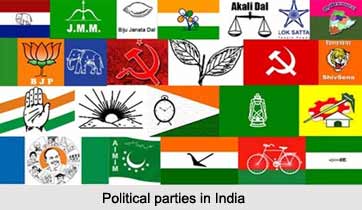
 Political parties in elections are the principle players around whom the entire outcome of the voting process hinges. Political parties are an established part of modern mass democracy, and the conduct of elections in India is largely dependent on the behaviour of political parties. Although many candidates for Indian elections are independent, the winning candidates for Lok Sabha and Vidhan Sabha elections usually stand as members of political parties, and opinion polls suggest that people tend to vote for a party rather than a particular candidate. Parties offer candidates organisational support, and by offering a broader election campaign, looking at the record of government and putting forward alternative proposals for government, help voters make a choice about how the government is run.
Registration with Election Commission
Political parties have to be registered with the Election Commission of India. The Commission determines whether the party is structured and committed to principles of democracy, secularism and socialism in accordance with the Constitution of India and would uphold the sovereignty, unity and integrity of India. Parties are expected to hold organisational elections and have a written constitution.
Recognition and Reservation of Symbols
According to certain criteria, set by the Election Commission regarding the length of political activity and success in elections, parties are categorised by the Commission as National or State parties, or simply declared registered-unrecognised parties. How a party is classified determines a party`s right to certain privileges, such as access to electoral rolls and provision of time for political broadcasts on the state-owned television and radio stations - All India Radio and Doordarshan - and also the important question of the allocation of the party symbol. Party symbols enable illiterate voters to identify the candidate of the party they wish to vote for. National parties are given a symbol that is for their use only, throughout the country. State parties have the sole use of a symbol in the state in which they are recognised as such Registered-unrecognised parties can choose a symbol from a selection of `free` symbols.
Ballot Papers and Symbols
After nomination of candidates is complete, a list of competing candidates is prepared by the Returning Officer, and ballot papers are printed. Ballot papers are printed with the names of the candidates (in languages set by the Election Commission) and the symbols allotted to each of the candidates. Candidates of recognised Parties are allotted their Party symbols.
Limit on poll expenses
There are tight legal limits on the amount of money a candidate can spend during the election campaign. For Lok Sabha seats in bigger states, it is Rs 25,00,000. In other states and Union Territories, it varies between Rs 10,00,000 to Rs 25,00,000. Similarly, for Assembly seats, in bigger states, it is now Rs 10,00,000, while in other states and Union Territories, it varies between Rs 5,00,000 to Rs 10,00,000. Although supporters of a candidate can spend as much as they like to help out with a campaign, they have to get written permission of the candidate, and whilst parties are allowed to spend as much money on campaigns as they want, recent judgments of the Supreme Court of India have said that, unless a political party can specifically account for money spent during the campaign, it will consider any activities as being funded by the candidates and counting towards their election expenses.
Splits and mergers and anti-defection law
Splits, mergers and alliances have frequently disrupted the compositions of political parties. This has led to a number of disputes over which section of a divided party gets to keep the party symbol, and how to classify the resulting parties in terms of national and state parties. The Election Commission has to resolve these disputes, although its decisions can be challenged in the courts.
Thus it can be seen that the political parties are the most important part of the election, for it is these very parties which are contesting the elections based on different political agenda.