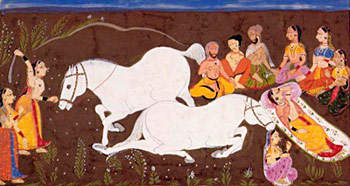
 The most popular Pashuyajna is the Ashvamedha Yajna or the horse sacrifice. According to the Yajurveda, the Hindu Kings conducted this sacrifice and the purpose was gaining of power and glory, the sovereignty over neighbouring regions, and general opulence of the territory.
The specification of the horse to be sacrificed must be a stallion and the age of the horse must be between twenty-four and hundred years. The horse is sprinkled with water, and the Adhvaryu and the sacrificer whisper mantras into its ear. If anyone stops the horse then he is cursed, and a dog is killed figurative of the punishment for the sinners.
The particular horse is then set off towards the Northeast, to roam around wherever it chooses, for the period of one year. The horse is associated with the Sun, and its yearly course. If the horse meanders around into nearby provinces aggressively to the sacrificer, they are subjugated. The wandering horse is feed by a hundred young men, sons of princes or high court officials, charged with guarding the horse from all dangers and difficulty. The king performs many rituals in the absence of the horse and after this horse returns to the kingdom other rites are executed.
The particular horse of the Ashvamedha Yajna is yoked to a golden chariot, together with three other horses, and mantra is narrated. The horse is washed and bathed, and then it is smeared with ghee by the queen and two other royal companions. The chief queen anoints the forequarters, and the others the barrel and the hind-quarters. They also decorate the horse`s head, neck, and tail with golden ornaments. The sacrificer offers the horse the remains of the night`s oblation of grain.
Hereafter, the horse with a hornless he-goat and a wild ox are bound to sacrificial stakes near the fire, and seventeen other animals are attached to the horse. The more the numbers of animals both tame and wild are tied to other stakes. Next the horse is killed. The main queen traditionally calls on the king`s official`s wives for pity and sympathy. The queens walk around the dead horse reciting mantras and hymns. The chief queen then has to mimic copulation with the dead horse, while the other queens ritually utter obscenities.
The next morning, the Purohitas or the priests raise the queen from the place where she has spent the night with the horse. He recites the Dadhikra verse, a verse used as a purifier after obscene language. The three queens with a hundred golden, silver and copper needles point out the lines on the horse`s body and cut the body parts into pieces. The horse is dissected, and its flesh roasted. Various parts are offered to several gods and personified concepts with cries of phrase `all-hail`. The priests performing the sacrifice were rewarded with a part of the valuables won during the wandering of the horse. It is said that the rewards from the east were given to the Hotar, while the Adhvaryu a maiden (a daughter of the sacrificer) and the sacrificer`s fourth wife.
In the epics the Mahabharata and Ramayana, the performances of the Ashvamedha are mentioned.