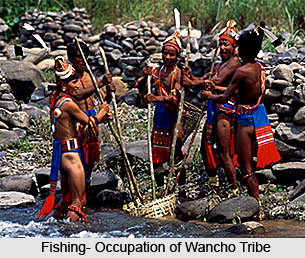
 Wancho economy has a subsistence economy based mainly on agriculture. Their livelihood depends chiefly on the field produce. Hence agriculture is their basic and primary occupation. Hunting, fishing, basketry, smithy, bead work, pottery, weaving, wood carving and grass-necklace work, are all inclusive in their source of income. Under patronisation from the government the products the products have reached the global markets. Even foreign countries have shown interest in these articles. The agricultural produce of the Wanchos, though not superfluous but plays a considerable role in the barter trade. Apart from agricultural work they have also taken up contracts works, trade and business and white collar jobs in the various government departments.
Land Use and Ownership Pattern
The Wanchos have four types of land such as village land, jungle land, reserved forest land and agricultural land. The village land often termed as Hamting is used for the purpose of construction of houses and for kitchen garden where fruit trees are also grown. The agricultural land called Jang is utilised for farming agricultural products like paddy, millet and other crops. In the Jungle land called Jan, house-building materials like bamboo, palm (Toko) leaf trees are grown. The reserved forest land is called Nokling.
Specific village boundaries are assigned to the villagers and the land within the boundary of a village belongs to the village community as a whole. Within the overall ownership of community, individual holdings like the village land and cultivable land also exist. They also have holdings over jungle land. The chief of the village neither has the ownership of the land nor has the administrative right of supervision. The individual holdings can be transferred, alienated, sold, mortgaged, given as gift or leased by the owner to a native of the village only. Land cannot be transferred to outsiders and even to a Wancho not belonging to the village.
Plots of Jhum marked separately and bestowed to individual villagers are cultivated for nine to ten years depending upon the number of plots. Each plot is cultivated for two successive years. If one year millet is grown the second year paddy will be grown. The Chief`s plot is the largest and the best. Those who do not have plots of land in the jhum field, cultivate on lease basis.