
The third yoga sutra explains about the elevated yogis, who are successful in channelising their energies towards an abundant flow of nature`s energy. Even if sadhana fails to to bring about a total transformation, a sadhaka`s path to evolution is certainly guranteed. When a yogi has been disciplined by yogic practice, he is successful in attaining evolution and emancipation. Thus, nature`s abundant energy aids a sadhaka to regularise his flow of energy, and gain spiritual growth and become liberated from pains.
nimittam incidental, instrumental, efficient cause, a pretext
aprayojakam not useful, of no use, those which do not move into action
prakriinam of natural tendencies or potentialities
oaranam covers, veils, obstacles
bhedah split, division, separation
m but, on the contrary, on the other hand,
nevertheless
tatah from that
ksetrikavat like a farmer, like a peasant, like a
husbandman
Nature`s efficient cause does not impel its potentialities into action, but helps to remove the obstacles to evolution, just as a farmer builds banks to irrigate his fields.
Culture of the germinated consciousness is of profound importance in yoga. As a farmer builds dykes between fields to regulate the flow of water, evolved yogis channelise the rich flow of nature`s energy to liberate themselves from the bondage of their actions and develop spiritual insight. Even if sadhana fails to give rise to complete transformation in the life of a sadhaka, it certainly serves to remove hindrances in the path of his evolution.
Previous good actions indirectly become instrumental in accelerating the flow of natural tendencies for the good of the consciousness. A farmer stacks up banks of earth to collect water and soak part of a field. When one area is soaked, he opens the bank to enable the water to flow into the adjoining area, continuing until the entire field is exhaustively irrigated. Then he sows the best seeds to get the best of harvests, and enjoys the fruits. Through yogic discipline, the yogi removes all obstacles to his evolution, and relishes emancipation.
Thus disciplined, the yogi`s enhanced energy spontaneously removes all fluctuations and afflictions which thwart his spiritual growth, enabling him to gain insight into his very being, his soul.
This sutra is a beauty in itself. Nature`s energy now flows profusely in the sadhaka. This energy is built up and concentrated through practice of osana, prdnaydma and bandha, which can be thought of as `dykes` in the system to regulate and channelise energy, so that mind and intelligence may permeate evenly throughout one`s being.
Judicious use of energy builds courage, strength, wisdom and freedom. This is cultivation of talent, which may transform itself to the level of genius. (1.2, 18, 29-39; n.2, 12, 13, 18; 11.29-m.15.)
Nimittam aprayojakam prakriinam varanabhedah tu tatah ksetrikavat
This is the third yogic sutra, which is incorporated in the fourth phase of the Patanjali Yoga Sutras.
Recently updated articles in Yoga
Khanda Manda Yoga
Khanda Manda Yoga is a difficult form of yoga where the Yogi cuts off his own arms and legs with a sharp cleaver, that is axe-like knife, and throws t...
Kaivalya Pada
Kaivalya Pada, the fourth chapter of Patanjali Yoga Sutra denotes an absolute, indivisible state of existence of the Yogi. The Kaivalya Pada is someti...
Vibhuti Pada
Vibhuti is the Sanskrit term for “power” or “manifestation.” In this third chapter, Patanjali introduces the final three limbs of Aṣṭanga Yoga, collec...

Sadhana Pada
Sadhana Pada in Patanjali Yoga Sutra denotes the idea of practicing yoga that leads to spiritual illumination. Sadhana, the Sanskrit term for “practic...
Samadhi Pada
Samadhi Pada is the first chapter of Patanjali Yoga Sutra. In this chapter, the author explains the essence of yoga, the nature of samadhi, and the me...
Related articles in Yoga
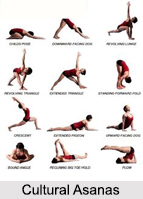
Cultural Asanas
Cultural Asanas refer to the daily physical exercise postures that train the body and mind in Yoga Practice.
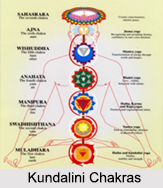
Kundalini Chakras
Kundalini Chakras are psychic energy centres or vortices, which connect between our psychic and physical energy systems.
Patanjali Yoga Sutras
Patanjali’s Yoga Sutras presents a foundational guide to the philosophy and practice of yoga. Through concise aphorisms, it outlines the nature of the...
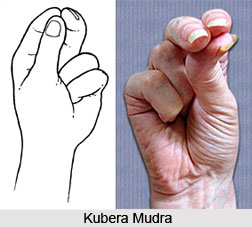
Kubera Mudra
Kubera Mudra, a form of Hatha Yoga, leads to the elevation of mental peace and physical relief by proper practice and cleanses frontal sinuses.