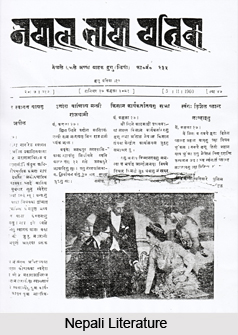
 Nepali literature wholly concerns itself and deals with the literature composed in the Nepali language. In this perspective of literature in Nepali language, a uniquely extraordinary fact can be rendered for useful purposes, integrally linked with Nepali and its acceptance in the pan Indian scenario. It is not always necessary that the said literature and its umpteen genres needs to be written by Nepali nationals, nor is it at all mandatory that the literature has to be written from the country itself, because, the language is extensively employed and made use of in various parts of India and Bhutan. In fact, the official language of the Indian state of Sikkim is Nepali. As a result, there exist numerous striking and high-flying writers of Nepali literature from other countries, particularly from India, as can be evidenced in Parijat (Bishnu Kumari Waiba was entitled Parijat, highly acclaimed in India for her undying courage and strength). There also survives an assortment and diversification of languages spoken in Nepal, like Maithali, Bhojpuri, Nepal Bhasa etc. The Nepali language is known to have flowered out from Sanskrit as a part from the whole. As a result, historians and researchers find it grossly difficult to state the ancient history of Nepali literature, because most antiquary luminaries had penned in Sanskrit, especially literature with a religious and spiritual inclination.
Nepali literature and its gradual germination can be approximately classified into five periods, namely:
• Pre-Bhanubhakta Era (from beginning to 1871 A.D.)
• Bhanu Bhakta Era (from 1872 A.D. to 1936 A.D.)
• Moti Ram Era (from 1940 A.D. to 1976 A.D.)
• Pre Revolution Era (from 1977 A.D. to 2007 A.D.)
• Post Revolution Era (from 2007 A.D. onwards)
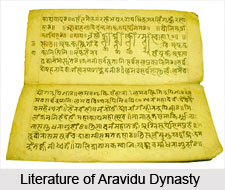
The oldest surviving evidence in Nepali literature that has been unearthed has been ascribed to Ashok Chilla`s bronze plate, engraved in 1321 A.D. The oldest book to have been discovered is Khanda Khadya (1642), the authenticity of the composer of which however still remains in the dark. Some of the other such instances of ancient books bearing no name of one sole creator comprise Swasthani Bharatkatha (1658) and Baj Parikxya (1700). Amidst such a darkening state of affairs, the oldest surviving book whose writer has been acknowledged is the translated version of Bani Bilas Jyotirbid`s Jwarup Pati Chikitsha (1773) and Prayashit Predip by Prem Nidhi Pant, in Sanskrit. Both the books were tranlated by Prem Nidhi Pant in later times.
Before the Gurkha (also acknowledged as Gorkha) conquest of Nepal in 1768, Nepali literature and Nepalese writings were performed in Sanskrit and Newari, as well as Nepali (the latter essentially serving as the language of the Gurkha conquerors). These writings consisted of religious texts, chronicles, dedications, extolments and the likes. The still surviving material in Nepali, with the feasible omission of the memoirs (c. 1770) of the Gurkha king Prithvi Narayan Shah, possesses more historical interest as opposed to literary pursuits. Literary composing in the Nepali language commenced only during the 19th century.
Approximately in 1830, there shot to prominence a school of Nepali poets, who penned on themes ranging from the Hindu epics Ramayana to Bhagavata-Purana, in a language that was more Sanskritised than Nepali. This genre in Nepali literature bore witness of being heavily influenced by classical Sanskrit themes and poetic metres. They were succeeded in mid-century by Bhanubhakta, whose Nepali version of the Ramayana had accomplished unfathomable popularity for the everyday and conversational touch of its language, its religious genuineness and solemnity and its down-to-earth natural descriptions. The poet Lekhnath Paudyal during the early 20th century also had inclined towards this `everyday and conversational touch` and thoroughly utilised the rhythms of popular songs in a few of his poems.