
The Fire God in one of the adhyayas of Agni Purana has also discussed the Nine-fold propitiation or what is known as Navavyuharchanam. It has been said that in the nine-fold propitiation the gods Vasudeva and Shankarshana together with the Beeja Mantras sacred to them, should be worshipped at the centre of the lotus-shaped mystic diagram. The god Pradyumnya should be worshipped in its southern petal, the god Anirudhya with the Beeja Mantra in the petal at its south-west. It has been said that similarly the boar manifestation of Vishnu should be worshiped in the petal at its north, as well as at the doors of the diagram, situated at its west and the north east.
Agni Purana says that the various Mantras hold a lot of prominence in the Navavyuharchanam. The ten Anga-pujas of Lord Vishnu should be duly performed, while the Ananta manifestation the deity should be worshipped below the mystic diagram, by reciting the Mantra running as "Obeisance to Ananta". The four pitchers (Ghatas) should be placed at the four gates of the mystic diagram, such as the east etc, and the latter-gods should be invoked and worshipped over them. In the entire process the preceptor should contemplate his psychic, self as having pervaded the universal space, and the Mantra known as the Atma Vija as dropping down with the moon-beam, saturated with the crystal drops of ambrosia, and entering his body from the above. Then he should deem himself as the absolute subjectivity (Purusha), evolved out of that mysterious Beeja, and hold himself identical with Lord Vishnu.
It has been narrated in the Purana that a mental worship of the god Hari, requires no flowers or offerings like the one made on the mystic diagram (Mandala). A strip of cloth should be tied round the eyes of the disciples, and they should be asked to throw flowers on the mystic diagram, divided into petals or chambers on which the names of the different manifestations of Vishnu had been previously written. The disciples should be respectively named after the gods, on whose chambers the flowers cast by them, would fall down. The preceptor should cause the disciples to be seated on his left hand side, and successively cast into the consecrated fire, hundred and eight libations of clarified butter, containing the seeds of Vrihi grass and sesame orientale. Again a thousand libations should be offered into the sacrificial fire, for the purification of the body of the disciple. Similarly a hundred libations should be offered for the propitiation of the different manifestations of the god Navavyuha, after which the final libation should be cast into the Homa-cavity. Thus a preceptor should initiate his disciples into the mysteries of the spiritual world, while they in their turn should worship him with presents and remunerations.
Navavyuharchanam
Navavyuharchanam according to the Agni Purana is a nine-fold propitiation. In the process Lord Vasudeva and Shankarshana are worshipped at the centre of the entire ceremony.
Recently updated articles in Indian Puranas
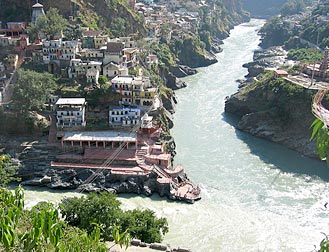
Mandakini, Holy River
Mandakini River is a significant Himalayan river in Uttarakhand, renowned for its ecological, cultural, and religious importance. Originating near the...
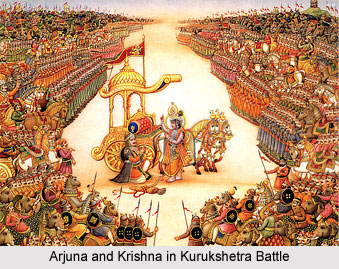
Kausika, Son of Vasudeva
Kausika is a minor figure in Hindu mythology and is identified in the Vishnu Purana as the only son of Vasudeva and his wife Vaishali. He is recognize...
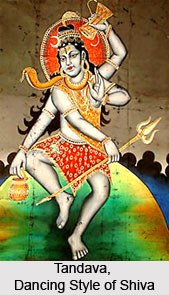
Tandu, Attendant of Lord Shiva
Tandu is revered as the divine attendant of Lord Shiva and the foremost exponent of the Tandava dance. According to the Natya Shastra, he instructed S...
Niramitra, Mahabharata
Niramitra was a son of Nakula and Kareṇumati in the Mahabharata. A descendant of the Pandavas and the Kuru dynasty, he fought on the Pandava side duri...
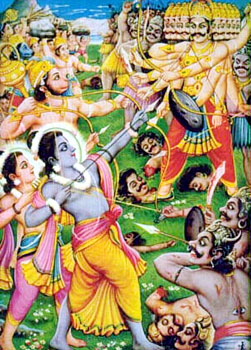
Mahodara, Ramayana
Mahodara was a prominent Rakshasa warrior, minister, and army chief who served under Rāvaṇa during the Battle of Lanka in the Ramayana. Celebrated for...
Related articles in Indian Puranas
Adhyayas in Agni Purana
Adhyayas in Agni Purana are all encompassing. The chapters have dealt with a variety of subjects related to human lives. A large number of chapters ha...
Indian Puranic Tribes
The existence of Indian Puranic tribes is often mixed with mythology and fiction that depict them as superhuman or sub.
Puranic Texts
Puranic Texts are vital according to Hindu, Jain or Buddhist religion; they describe the history of the Universe.

Puranic Shaivism
Puranic Shaivism established during the Gupta Dynasty. This puranic religion developed and expanded, and was accompanied by the development of Brahman...

Nilamata Purana
Nilamata Purana is a Kashmiri Purana that is referred by Kalhana. It is considered as one of the sources of ancient history of Kashmir.