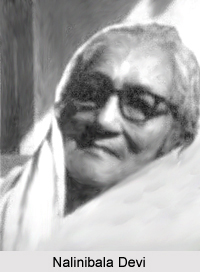
 Nalinibala Devi (1899- ) is a notable modern Assamese poetess. She became a widow rather early in life. This cast a deep gloom over her life, but she weathered the crisis in the characteristic way of enlightened Indian womanhood. In her search for consolation and light she enquires into Indian philosophy, more particularly the Gita, the Upanisads and the literature of the Assamese Vaisnavite saints, and these studies foster in her a serene meditative mood and deep faith and hope in God. She is also attracted by the poetry and philosophy of Rabindranath Tagore whose influence can be detected in her thought and diction. A mystic poetess, Nalinibala Devi has an undefined restlessness - a craving for something which eludes definition and specification. This same central theme informs all her three poetical collections - Sandhiyar Sur (The Music of Sunset), Saponar Sur (The Music of Dreamland) and Parasmani (The Philosopher`s Stone). Running through all her poems there is the deep feeling of a heart lacerated by the sorrows and sufferings of life, and a marked characteristic of many of her poems is a purity of soul achieved through suffering.
There is also an over-powering desire for union - the union of the individual soul with the universal and supreme soul. This latter is conceived sometimes as her beloved and sometimes as the Infinite and the Beautiful. She feels a touch of this eternal Beauty in all the objects of Nature, whose pied beauties are collectively the beauty of their maker. The seasons and the ever-changing loveliness of external Nature are but manifestations of that universal spirit, between whom and the poet Nature herself acts as the point of contact and the medium of union. The lightning, the Keteki`s lenitive song, the gentle zephyr of the dawn, the profound silence of the night, the smell of the wild jasmine,- all these give her intimations of the Supreme Deity, and not only serve as offerings to Him but also deeply humanise her.
These help her in explaining the supreme truth, and add to the beauty of her poetry. Writing about Saponar Sur, Shri Krishna Kanta Handiqui has observed that these poems are not pessimistic but actually disclose a deep faith in man`s infinite future and the immortal nature of the spirit of man. Param-Trsna (The Supreme Thirst) is a single long poem of Nalinibala Devi, in which there is an explicit statement of some of her philosophic beliefs. She believes that the soul of man, especially that of a poet, has an eternal thirst which does not let him rest, although he may be surrounded by infinite riches and beauty, and that the journey of life is not a new thing. Like God, His creations, including human life, are also endless. That same eternal nature of the stream of life has made it inevitable that man`s relationship with Nature should be as old as creation. The same spark illumines both Nature and Man. Hence it is that fragrance and buds, breeze and brooks, hold out so much meaning for man. Param- Trishna is, however,` not a bundle of wilfully esoteric renderings or uncritically glorified philosophy. It abounds in vignettes of nature, which are not a mean source of the pleasure of the poem.
Nalinibala Devi`s father, the late Nabinchandra Bardoloi, was a front-line leader of the Indian Freedom Movement. She has written a fine biography of her father. As was to be expected, she imbibed her father`s patriotism and wrote some patriotic poems in which her love of the fatherland and its glorious past is expressed with an intense and insistent passion. The beauty that was Bharat is disclosed side by side with the beauty that Assam was. Bharati (Indiana), Rabindra Tarpan (Homage to Rabindra), Mahanadar Atma-kahini (Auto-biography of the great river Brahmaputra) are some such patriotic poems. Janmabhumi (The Land of Birth) is a matchless expression of the poetess`s intense and overflowing love for her motherland. She wants to be allowed to serve, even after her own death, the land of her birth which is admittedly superior even to heaven. A word must be said regarding her technique. The roll, the rise, the carol and the evocation of her poetry are exquisitely musical. She has copiously drawn on the rich treasure house of Sanskrit, and her similes, imagery and vocabulary are enriched by the sublimity of that literature.