
Nada in Indian Music is a sensation that is caused by some oscillatory motions of the body particles. The effect of oscillatory motions is transmitted through some medium, like the atmospheric air, to the ear. This has certain impressions on the nerve that corresponds to the nature of original motion that is the cause of the sound.
There are two types of Nada: musical and unmusical sound. Both these types can be created by any sudden and enthusiastic wave and energy. When such a wave becomes irregular, it is known as unmusical sound. It has immense variety according to the nature of the cause. However when the motion of sound is habitually repeated at equal and small intervals of time it is known as musical sound. The unclear and noisy nature is lost making the sound more uniform and agreeable.
Scholars of music have given three names depending on the function of the musical sound: pitch of the sound, the intensity of the sound and the character of the sound.
Pitch refers to the position of any sound in acute and quality musical scale. In between the distinctions are known as acute, high, low, grave, deep, sharp, flat and so on. These distinctions depend on the rapidity of the particles of the air that is in contact with the ear. Low vibrations give low tones and high vibrations produce a sharp tone. The pitch of a musical sound is decided by the rapidity with which the sounding body`s vibration succeeds each other. The quicker the vibration succeeds, the higher the pitch of the note, the slower the succession of the vibration the lower is the pitch.
The extent of loudness depends on the amplitude of the vibration and the corresponding strength of the disturbance of the air in waves that are transmitted. Longer vibrations produce greater intensity of motion thereby causing an impression of greater force that is to be made on the nerves of the ear. This is known as sound intensity.
The character of a sound indicates its sources of production. It also means the character of the tone that is produced from human voice and other musical instruments.
Ahata (struck) and Unahata (un-struck) are the other two varieties of Nada. Ahata Nada is an output of the union of Prana and agni. Anahata Nada is the inner sound that travels from the Navel to the throat. Anahata Nada permeates the entire universe through inhaling and exhaling.
Nada in Indian music
Nada in Indian Music is the only property of music. It is also referred to as the sound.
Recently updated articles in Music in India
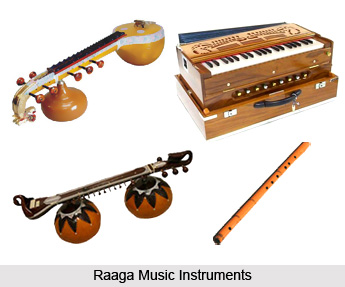
Classification of Raagas in Carnatic Music
Classification of Raagas in Carnatic music is based on scale type, devised as a system for raagas that existed as well as those that were in the proce...
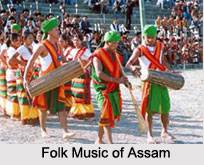
Folk Music of Assam
Folk Music of Assam reflects the outdoor and indoor life of the folk people and it does not follow any strict rule of composition and performance. Fol...
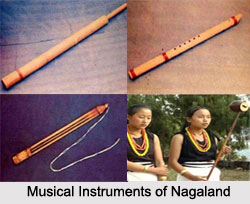
Musical Instruments of Nagaland
Musical Instruments of Nagaland reflect its rich tribal heritage and deep cultural roots. Crafted from natural materials like bamboo, wood, and animal...

Rasa, Hindustani Music
Rasa is an important part of Hindustani Music. Here the creative experience of the artist i.e. musician and the aesthetic response of the connoisseurs...
Kshetrajna, Telugu Poet and Composer
Kshetrajna (1600 - 1680) was a creative Telugu poet and composer of Carnatic music. He composed several padams and keertanas.
Related articles in Music in India
Kriti Carnatic Music
Kriti refers to one of the most widely used genres of Carnatic music. It originated from the kirtanas of the bhaktas, i.e., musicians who expressed th...
Indian Folk Music
Indian Folk Music is full of rustic charm. The appeal of Indian folk music lies in the simplicity of its style and lyrics. Most of the folk songs are...
Haryanvi Music
Haryanvi music is the folk music of the state of Haryana and is sung in western Uttar Pradesh along with the neighbouring districts of Rajasthan and P...
Carnatic Music
Carnatic music, also known as `Karnataka Sangitam`, is one of the two styles of Indian classical music.