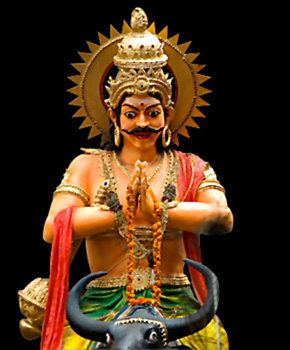
 Vishnu Purana states that all those men whose minds are dedicated to Lord Vishnu always achieve Mukti from Yama. In this regard Vishnu Purana says that Yama has said that no such man should be brought to his court who has obtained the shelter of the lord. This is because Yama is the lord of spirits but not the lord of those spirits who are dedicated to the lord. The function of Lord Yama is to sit in his court and carry on judgment as to what is right and what is wrong but he is not independent, Hari is his lord and Hari has the capacity to mete out punishment even to Yama.
The Purana says that he who reverentially bows unto Hari, whose lotus-feet are being meditated upon by the celestials, is freed from all iniquities. Lord Yama orders his servant that such a person should be avoided from his court. Similarly a man who is free from the bonds of sin and wrong deeds are also outside the grip of Yama.
Vishnu Purana in its account of Mukti from Yama has also elaborately discussed as to how the messenger of Yama is supposed to distinguish a worshipper of Hari from the one whose soul is not dedicated to the lord. Yama has said that a man can be considered a worshipper of Hari if he never swerves from the duties assigned to his caste, who regards with an impartial eyes his own self, his friends and enemies, does not steal or injure any body and one whose mind is freed from all passions. Similarly a man who meditates upon Janardana, whose mind is freed from illusions and he who devotes all his thoughts to the Lord is also called a true devotee of Hari.
Vishnu Purana also mentions that Lord Vishnu does not live in the hearts of those men sullied with malice and envy. It has been said that Vasudeva always resides in his heart whose mind is pure, free from malice, quiet, which has a pure character, is a friend to all, speaks wisely and kindly and is humble and sincere. When the eternal Vishnu resides in the heart of man he appears lovely to all. Yama has advised his messenger that he should keep away from those whose sins have been washed away by self-control and moral discipline, whose minds are always devoted to the undecaying and who are freed from avarice, unkindness and malice. Rather it can be said that if the divine Hari who is without beginning or end lives in the heart of a man is freed from all sins.
On the other hand he, who pilfers another`s wealth, slays animals, speaks untrue and cruel words, whose mind is impure and is addicted to impious actions, does not get the Endless in his heart. Janardana does not reside in the heart of those who cannot bear the prosperity of others, who does not perform sacrifices and does not make gifts to the pious and also those who earns wealth by foul means.
A man becomes a beast when he is not a follower of Vasudeva. An individual whose mind is addicted to foul actions, who is always engaged in vile actions, who lives for a long time in evil company and who always endeavours to drown himself in sins cannot be protected from the clutches of Yama. It has been narrated in Vishnu Purana that an individual in whose heart dwells the imperishable soul he is protected against all kinds of danger and death.
In conclusion it can be said that they whose minds are always devoted to Keshava, have no fear from death or Lord Yama, his servant, his rod, his noose and his tortures.