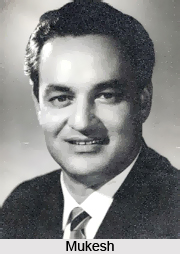
 Mukesh Chandra Mathur, the finest Hindi playback singer, was born in Delhi on 22 July 1923, in a small middle class family. He was nicknamed as `The Man With the Golden Voice` for his melodious voice and immense potentiality in music. Mukesh was the sixth in a family of ten children. Father Lala Zorawar Chand Mathur was an engineer and mother was Chand Rani. From his boyhood, Mukesh was inclined to music and thought music as his destiny. The music teacher who came home to teach Mukesh`s sister Sundar Pyari, found a willing but secret pupil in Mukesh, who used to listen in from the adjoining room.
After completing his matriculation in 1940, Mukesh took up a job in Delhi Department of Public Works. During this time, Mukesh experimented with voice recordings and gradually developed his singing abilities. He had already given up his job as an assistant surveyor at his father`s workplace. At the age of 17, he came to Mumbai to become a singer. Mukesh`s father was not at all interested but gave in to the persuasion of his wife and brother and so, it was a singing career for the teenaged Mukesh.
The melodic voice of Mukesh was discovered by character actor Motilal in 1940. Mukesh was noticed while singing at his elder sister Ram Pyari`s wedding. This first impression of Mukesh`s voice created a good impact on Motilal who invited Mukesh to stay at his residence in Mumbai. He also engaged the legendary Pandit Jagannath Prasad to train the young singer. The sincerity in Mukesh and his passion for singing may have inspired directors to cast him as a singing hero. This budding singer of that time, Mukesh, was an ardent admirer of the great K. L. Saigal, probably the greatest singer hero of those times. During this period, Mukesh bagged a role in a Hindi film, Nirdosh in 1941. His first song was a ghazal `dil hi bujha hua ho to` composed by Ashok Ghosh as an actor singer for Nirdosh opposite Nalini Jaywant. His acting and singing career further proceeded as he acted in `Sukh dukh` opposite Sitara Devi. The music for the film was directed by the revered Khemchand Prakash. This was followed by `Adaab arz` in 1942.
 Mukesh got his break as a playback singer in 1945 with the film `Pehli Nazar`. The first song he sang for a Hindi film was `Dil Jalta Hai to Jalne De`, which was incidentally picturised on the actor Motilal. Mukesh`s singing became more noticed when he sang for Motilal in the film `Moorti` in 1945. Here Mukesh sang two solos `Maana ke tum haseen ho` and `Haseenon se haseenonko`. The first glimmer of stardom came with the hugely successful `Dil jalta hai` from the film `Pehli Nazar`. Here Mukesh`s open and uninhibited admiration of K. L. Saigal was on full display in his singing. In fact the young impressionable Mukesh had heard his adored idol in the immortal `Jab Dil Hi Toot Gaya` and yearned to sing a song like that. Anil Biswas turned his dream to reality. When `Dil jalta hai` was heard, thousands of music lovers mistaken to be the voice of Saigal as Mukesh had effectively cloned his hero. Even Saigal himself was surprised after hearing the song.
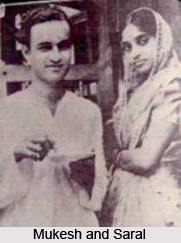
Mukesh got married in 1946 to Sarla Trivedi, daughter of a Gujarati Brahmin millionaire, in a temple in Kandiwali, at the residence of Mr. R. D. Mathur. The couple was blessed with five children as Rita, Nitin, Nalini, Mohnish and Namrata (Amrita). Mukesh is the grandfather of the present Bollywood actor Neil Nitin Mukesh. In 1953, Mukesh co-starred with Suraiya in `Mashooqa` and wind up his acting carrier in 1956, he starred in his last film `Anurag` with Usha Kiron. In this movie, Mukesh came up with another talent and was admired for this great job for composing the songs `Kisse Yaad Rakhoon` and `Pal bhar ki pehchan` are part of this collection. Though Mukesh`s burning desire was to follow in the footsteps of K.L. Saigal, veteran composers Naushad and Anil Biswas would have none of it. They took it upon themselves to wean Mukesh from his Saigalesque inclinations.
Veteran composers Naushad and Anil Biswas tried to bring out the actual singer and individuality of Mukesh and part him from his Saigalesque inclinations. They succeeded in doing this with the song `Jeevan Sapna Toot Gaya` in 1948. Naushad insisted on pulling up Mukesh sternly whenever he imitated Saigal. He brought out his individualism in several early songs for Dilip Kumar like `Gaye Ja Geet Milan Ke` and `Hum Aaj Kahin Dil Kho Baithe`. The voice of Mukesh was too much associated with the songs that people could not imagine the songs in any other voice.
Mukesh sang the songs for Dilip Kumar in Mehboob`s `Andaz` in his singing career. In fact, the great female voice of Lata Mangeshkar was introduced to the Bollywood film industry by Mukesh. He insisted that Lata meet Naushad and when the then struggling phenomenon was reluctant, he personally accompanied her to the composer`s residence. Lata`s big break in `Andaz` was brought by Mukesh and she never looked back after that. Generosity, benevolence and sincerity were second nature to Mukesh. These attributes were the reason for his long-standing relationships with actors, composers and co-singers.
The most memorable and cherished of all was the relationship of Mukesh with Raj Kapoor. The famous Bollywood singer is best known for the songs he sang as a playback singer for Raj Kapoor, a legendary actor and director of Bollywood in the 1950s and 1960s.
 The friendship of Raj Kapoor and Mukesh started after their first meeting on the sets of `Bansri`. Raj Kapoor was introduced as Prithviraj Kapoor`s son. The first meeting turned to a great friendship with the progression of time. The two figures of the Bollywood film industry decided to work together and Mukesh sang for Raj Kapoor in his first film `Neel Kamal`, as leading man. From that day on, till his sudden tragic death Mukesh was Raj Kapoor`s voice in the actor`s own productions as well as in all leading outside banners. Mukesh`s sweet, vulnerable and extremely sincere voice articulated the emotions of Raj Kapoor, the `Indian tramp,` very effectively. Songs like `Awaara Hoon`, `Mera Joota Hai Japani` could not have been sung by anybody else. Raj Kapoor`s screen persona cannot be so closely identified with Mukesh`s voice because the two were so entirely compatible. The musical `Dum Dum Diga`, the plaintive `Aansoo Bharthain`, the sweetly rustic `Sajan Re Jhoot Mat Bolo` and the heart wrenching `Jaane Kahan Gaye Woh Din`, were songs that typified the films and character of Raj Kapoor.
Mukesh died of a heart attack on 27 August 1976 in Detroit, Michigan, USA, where he had gone for a concert. His body was carried back to India by the great Indian singer Lata Mangeshkar. A grand funeral ceremony took place and many prominent personalities, actors, personalities of the Indian film industry, and fans paid tribute to the Indian singer. The death news of Mukesh made Raj Kapoor remark "I have lost my voice." These words by Raj Kapoor were a testimony to the timeless and unforgettable association of Mukesh`s voice in playback to the immensely popular songs of Raj Kapoor`s films.