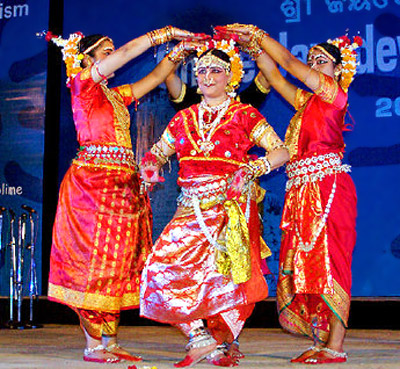
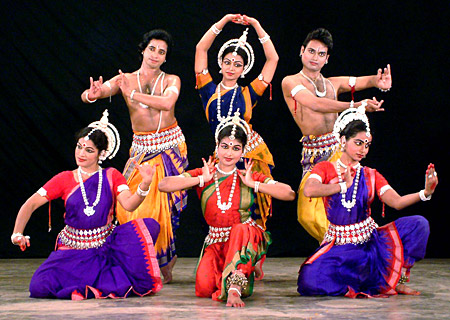
 Mudras or Hastas, as they are generally called, constitute a characteristic feature of Indian Classical Dances. This is an element which distinguishes Odissi from dance forms in other parts of the world. Interpretative dancing in particular depends largely on these hastas. Mudras are also used in nritta or pure dance but not for any interpretative purpose. They are used for their decorative effect only. In Nrittya or interpretative dance, the hastas serve as a gesture language which endeavours to convey the meaning of the idea to be portrayed. It is said that corresponding to the hastas involved, the emotions and sentiments are also expressed through the eyes.
In Odissi the hastas constitute as essential a part of the technique as in the case of Bharat Natyam and Kathakali. It is said that in Odissi dance the total number of hastas is 28 which is same as the number of asamyuta hastas and they are called samyuta or asamyuta according to their usage. The mudras used in Odissi dance can be classed under two groups for convenience, textual and traditional. Of the twenty four asmyuta hastas of the Natyashastra, twenty are used in Odissi. It is said that of the twenty eight asamyuta hastas of Abhinaya Darpana twenty four are followed in Odissi. In fact in no other classical dance of India such a number of asamyuta hastas are used.
The detailed study of Odissi shows that the mula hastas or basic hand-gestures are more frequent in this dance than in any other classical dance of India. Though Vaishnavite influence is clearly discernible in the abhinaya aspect of Odissi, pure dance predominates the tradition which perhaps evolved from the Buddhist and Shaivite dances prevalent earlier. The Buddhist dances followed Bharata`s code as evident from the sculptures and later writings. In the dance sculptures of Orissa, the Pataka Ardhapataka, Arala, Suchi, Shukachanchu, Alapadma, Ardhachandra, Kapitha, Katakamukha, Hansasya hastas are seen in large number. In the present form of Odissi the Pallava, Keshabandha, Karihasta and Latarabya Nritta Hastas of the Natya Sastras are often used. Pataka, Tripataka, Shikhara Kapitha, Alapadma, Hamsasya, Dola, Puspa, Suchi and Mayura Hastas are also very commonly used.
Most of the mudras in Odissi are used for abhinaya which is always accompanied by songs composed by the ancient poets of Orissa such as Jayadeva, Upendra Bhanja, Kavisurya Baladeva Ratha, Banamali Das, Gopalkrishna Pattnaik, Dinakrishna and others. Some of the compositions are highly ornamental and the words therefore sometimes convey more than one meaning. Hence different hastas have to be used to convey the meanings of a single word or a line.