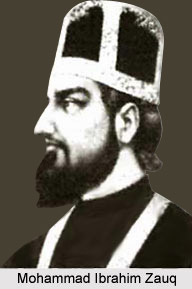
 Sheikh Muhammad Ibrahim Zauq, born in the year 1789, was a renowned Urdu poet. He also wrote poetry under nom de plume "Zauq", and was appointed poet laureate of the Mughal Court in Delhi. His childhood was spent in a poor background and acquired some ordinary education. Later of course he went on to gain knowledge in history, tradition and astrology in his later years. Sheikh Muhammad Ibrahim Zauq was a well-known contemporary of Mirza Ghalib and in the history of Urdu poetry the rivalry of the two poets is quite well known. During his lifetime, Sheikh Muhammad Ibrahim Zauq, was more popular than Ghalib for the critical values in those days were mainly confined to judging a piece of poetry on the basis of usage of words, phrases and idioms. Substance and style were barely taken into account while appreciating poetry
Early life of Sheikh Muhammad Ibrahim Zauq
In the year 1789, Zauq was born at Delhi. Sheikh Muhammad Ramzan, his father - was a lowly placed soldier in the Mughal army. It was no less than a miracle that Zauq, without having the proper treatment on account of the penury of his family, survived the attack of a dreaded malady like smallpox during his childhood.
As a came from a very modest background, his father did not have any means to equip his son with the best available education of the time. He was also sent to maktab (elementary religious school) that was run by Hafiz Ghulam Rasool - who himself was a poet and used Shauq as his nom de plume. Under his influence young Muhammad Ibrahim also got attracted towards poetry.
Though Zauq could not complete the course of the Maktab, he got hooked to poetry. In those days Shah Naseer was the most famous master poet of Delhi. Zauq began showing his Ghazals to Shah Naseer for improvement. Naseer recognized the natural talent and made him his pupil. Gradually, Zauq began participating in the mushairas. His natural bent of mind towards poetry coupled with his singular obsession to excel in the pursuit brought him fame and fortune. He would be better appreciated in the mushairas than his mentor. Shah Naseer got very annoyed with the growing popularity of Zauq. He threw him out of the group of his pupils. Zauq, thereafter, relied only on his talent and continued writing poetry with a vengeance.
Another poet, Meer Kazim Husain Beqarar, a friend of Zauq`s was appointed the mentor of the Crown Prince Zafar, who later ascended the throne. Through him Zauq could get the chance to enter the royal court.
Zauq`s reputation in Urdu poetry is because of his eulogies that reflect his command over the language and his expertise in composing poetry in extremely difficult meters. Since he got associated with the royal court right from his teens and remained there till his death, he had to write mostly eulogies to seek the patronage and rewards from the princes and the King. His mentor, Shah Naseer, would also pay attention only to the linguistic eloquence and mastery over prosody. Zauq also emulated the example of his mentor. Such style of poetry suits eulogy writing. Many critics regard him a great eulogy writer next only to Sauda.
His Ghazals also have some literary values. Since Bahadur Shah Zafar was fond of using simple and colloquial diction, Zauq too composed his Ghazals using simple words, phrases of everyday use and similes rooted in the common culture. His Ghazals are also notable for their spontaneity. Zauq was a deeply religious man. In his Ghazals too he would deal with religious and ethical themes. Therefore, his Ghazals lack lyricism and appear to be the verses of a preacher.
Zauq died in 1854, and today his grave lies in a by lanes of Paharganj, Delhi. His grave was restored after the Supreme Court of India orders in early 2000s, but his home in nearby Nabi Karim area, was never identified.