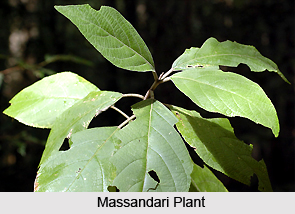
 Massandari is a shrub or a small tree which is of great medicinal use. The botanical name of Massandari is Callicarpa tomentosa (L.) Murray. This shrub is known by various names in different languages in India. It is known as Muttura in Bengali, Bastra in Hindi, Chruthekku, Nallapompil, Nai-kumbil, Pichenkala, Teregam, Thinperivelam, Temperuvallam, Tondi and Tontitterakam in Malayalam, Katko-mal, Vetrilaipattai, Vetti-laipatta, Kattukkumil and Vettilaippattai in Tamil, Ardri, Ibbanne, Ruchipatri and Doddanathada gidda in Kannada and Aisar, Karavati, Pondi and Isvar in Marathi. It grows to a height of about eight meters and is found in almost all parts of India.
Massandari is grows up to about eight meters. The bark is soft and grey in colour, with a peculiar, slightly aromatic odour. The branchlets are densely-clothed with an easily detachable felt of grey or fulvous stellate hairs. Leaves of Massandari are generally crowded at the ends of branches, ovate or elliptic-lanceolate, 15 to 23 centimeters long and 7.5 to 10 centimeters wide, margins entire or toothed, apex acuminate, base rounded, acute or cordate, dark green, smooth above, with dense yellowish-grey tomentum beneath. The main nerves are 6 to 9 pairs and the petioles are 2.5 to 4.5 centimeters long, stout, tomentose. Flowers of Massandari are pink or purple, borne in divaricately branched, tomentose axillary cymes; bracts linear, to 1.2 millimeter long; calyx 2.5 millimeter long, campanu-late, faintly 4-lobed; corolla 4 millimeter long, glabrous, tube 2.5 millimeter long, campanulate, lobes 4, unequal, sub quadrate, rounded. Fruits of this medicinal plant are green and turn purple or black when ripe, globose, and 4 millimeter in diameter, shining and smooth.
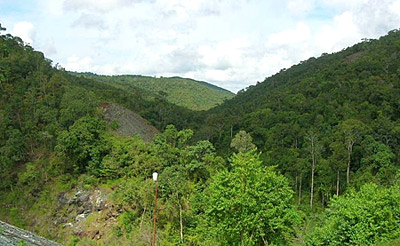
Massandari is distributed widely in most parts of India. In is mainly found in the Konkan and in the evergreen forests of the Western Ghats in the state of Karnataka, Maharashtra, Kerala and Tamil Nadu at an elevation of 1200 meters, typically at the edges of forest clearings.
An aqueous extract of the leaves of Massandari is used as an antiseptic to dress wounds and boils, and also to relieve itches. Boiled in milk, the leaves of this plant are used as a mouthwash to relieve aphthae. The roots are used to treat skin affections in the northern parts of India. A decoction of the roots and bark is reportedly used remove hepatic obstructions, to relieve fever and to treat skin diseases. In Ayurveda, the fruit and flower of Massandari are used as a substitute for those of Callicarpa macro- phvlla (Privangu in Sanskrit language) to treat epilepsy, diseases of the nervous system, oedema, Haemorrhage or Rakta Pitta, Dysuria or Mutrakrichha and cardiac diseases.