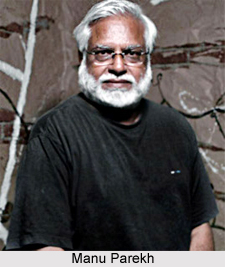
 Manu Parekh was born in Ahmedabad in 1939 in Gujarat. He got the Diploma in Drawing and Painting from Sir J. J. School of art, Mumbai. In 1962, Manu started as a stage actor in Bombay and designed stage-sets in Ahmedabad. Thereafter he entered a different field when he joined the Weavers` Service Centre, Bombay, in 1963 as Art Designer. After two years he moved to Calcutta and lived and worked there till 1974, when he was appointed a Design Consultant by the Handicraft and Handloom Export Corporation of India, New Delhi.
His paintings have always had a concern for man`s social being. His paintings of the seventies were marked by a gloom and sinister apprehensions, which changed over the years to a long series of paintings with oppressive sexual symbolism. His later paintings focus on man`s tainted and abusive existence.
He won President of India`s Silver Plaque and cash award for best painting of the year from the All India Fine Arts and Crafts Society, New Delhi (1972), Birla Academy`s cash award (1971), another award from the AIIFACS, New Delhi (1974), National Award from the Lalit Kala Academy, New Delhi (1982), and Padma Shri from the Government of India (1991).
Parekh`s early work explored the relationships between man and nature. Polemics have always intrigued him - the energy of the organic form and the inherent sexuality within these forms are major elements in his works. His paintings provoke the viewers to consider the world around them through emotion, pain and anguish expressed in his paintings. His colours and forms radiate a volatile energy which is an extension of the artist`s personality.
Vivid colours and prominent lines are an integral part of his works. Parekh has been strongly influenced by his surroundings. His stay in the city of Calcutta, for instance, drew him towards Shantiniketan and the old masters of Indian art, Ram Kinkar Baij and Rabindranath Tagore. Banaras as a city played an integral role in Parekh`s work after his first visit there following the death of his father. Parekh also highlights his relationship with his wife Madhvi who is also a self taught artist.
Manu Parekh feels that India is an artist`s delight because of its "cultural diversity". However rural lifestyle as such has never influenced his work.