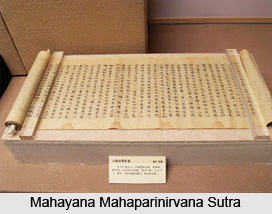
 Mahayana Mahaparinirvana Sutra or Nirvana Sutra is a Buddhist Sanskrit text of hybrid formation.
Origination of Mahayana Mahaparinirvana Sutra
Mahayana Mahaparinirvana Sutra is one of the Tathagatagarbha sutras of Mahayana Buddhism. Mahayana Mahaparinirvana Sutra originated in the first century in Andhra Pradesh in South India.
Composition of Mahayana Mahaparinirvana Sutra
Mahayana Mahaparinirvana Sutra was substantially expanded by the Chinese translator Dharmaksema in the fifth century CE. Its teachings on the Buddha-nature and the possibility for all sentient beings to attain Buddha hood had a great impact on East Asian Buddhism.
Text of Mahayana Mahaparinirvana Sutra
The text of Mahayana Mahaparinirvana Sutra in the original Sanskrit has survived only in a number of fragments, which were discovered in Central Asia, Afghanistan and Japan. It exists in Chinese and Tibetan versions of varying lengths. There are four extant versions of the sutra, each translated from various Sanskrit editions.
Indian version of Mahayana Mahaparinirvana Sutra
The Indian version of Mahayana Mahaparinirvana Sutra underwent a number of stages in its composition. Masahiro Shimoda discerns two versions.
Evidences of Mahayana Mahaparinirvana Sutra
Mahayana Mahaparinirvana Sutra is also evident in cave complex associated with the Mahasamghika sect. Karla Caves of Maharashtra. The scholars believe that the compilation of the core portion must have occurred at an early date, during or prior to the 2nd century CE, based on internal evidence and on Chinese canonical catalogs.
Textual Evidence of Mahayana Mahaparinirvana Sutra
Based on the textual evidence in Mahayana Mahaparinirvana Sutra and related texts, Stephen Hodge estimates a compilation period between 100 CE and 220 CE for the Mahayana Mahaparinirvana Sutra.
Indian dissemination of Mahayana Mahaparinirvana Sutra
The history of Mahayana Mahaparinirvana Sutra is extremely complex, but the consensus view is that the core portion of this sutra was compiled in the Indian subcontinent, possibly in Andhra Pradesh.
Language of Mahayana Mahaparinirvana Sutra
The language used in Mahayana Mahaparinirvana Sutra and related texts seems to indicate a region in southern India during the time of Satvahana Dynasty. The Satvahana rulers gave rich patronage to Buddhism, and were involved with the development of the cave temples at Karla and Ajanta, and also with the Great Stupa at Amaravati. During this time, the Satvahana Dynasty also maintained extensive links with the Kushana Empire.