
The Kharia Tribe, after their alliance with the Hindus, developed a sense of sacredness and established several sacred centres on the Hindu model. Their affiliation with numerous Hindu rituals culminated in celebration and observance of countless festivals such as Ramnavami celebrated in the month of Chait Navami (9th day of Chait). Gradually it emerged as a significant festival of the Kharias, celebrated in the sacred centres where Mahabiri Jhanda is planted. The Mahabiri flags (religious flag connected with Lord Hanuman) are collected in a procession organised on inter-village level. Some of the sacred centres where Mahabir Jandas are collected are Palkot and Pojenga, Kali Mandir near the premises of Ganga Maharaj of Simdega and the Gumla court. The Kharias accompanied by other tribal groups and Hindus, visit these spots during Ramnavami carrying Mahabiri Jhanda from their respective villages. Majority of these areas are located in the non-christian Kharia regions, though few might be found in the Christian area as well, like villages Paledih, Biru and Sitndega.
Ramnavami is originally a Hindu festival but the Kharias have inculcated it in own culture and have been celebrating it for nearly last four decades. The festival is marked by celebrations of several fascinating rituals and sacred performances. The village members contribute money according to their capacity. Important items such as kapur (camphor), two kaseli (betel nuts) two pan (betel leaf), milk, incense sticks, ghee (clarified butter), and vermillion are required for the puja. For its celebration food items such as Halua, Sirni, coconut and banana are required and served to the presiding deity.
On the festive day the Pahan (village priest), observing fast, brings with him a pot full of water, leafy branches of mango tree, paddy shoots, chaumukh dia (for mouthed earthen lamp) and cotton for the wick. The puja commences with the Pahan marking the kalsa (a ritual pitcher filled with water) and an image of Lord Hanuman with five vermillion marks. Fire oblations are also offered to the god with incense sticks. Before offering the ritual bhog to the lord a portion of it is kept aside on a banana leaf placed before the image of the Lord. Subsequently, the Mahabiri Jhanda, triangular in shape with a height of almost two feet, is fixed tightly on the top of a big bamboo and erected perpendicular to the ground fixed in a hole. The flag is almost two feet in height while its other two sides are nearly five feet in length.
The Mahabiri Jhanda, before being taken door to door in a procession, is worshipped by some married Kharia women who wash its lower portion puts five vermilion marks on it. Thence, they perform Gorlagi, a ritual salutation to the Jhanda. After travelling around the village the flag is brought back to its original place and fixed tightly in the hole.
A second flag, also triangular in shape yet bigger in size, almost ten feet in height with the other two sides measuring twenty feet in length, is scaled up on a bamboo. The community members marching for a procession carry weapons like lathi, balua, sword, bow and arrow. Specific musical instruments such as Dholak, Nagara and other gadgets are also brought into play during the procession, participated by men, women and children alike.
Gradually the procession approaches near an appointed destination, usually a school ground or any other public place, locally known as `centre for Jhanda milan` (meeting of the Jhanda). In Baghima area, the Baghima Middle School is the meeting point while in Simdega area, the Paledih high School serves as the gathering spot. The flags are fixed firmly in a way that forms a circle within which the people display a mock fight using their weapons.
During the Mahabiri Jhanda Festival, a grand fair is organised, that catches the fancy of not only the Kharias but also a large number of local Hindus residing in the region.
Mahabiri Jhanda
Mahabiri Jhanda, is a sacred pilgrimage centre of the Kharias that pays host to few rituals celebrated during Ramnavami in the month of Chait Navami in reverence to Lord Hanuman.
Recently updated articles in Tribes of India
Arakh Tribe
Arakh Tribe is one of the ancient tribes located in several parts of central India. Their origin dates back to the Tughlaq era. Arakh tribe appears to...
Traditional Dress of Nyishi Tribe
Traditional Dress of Nyishi Tribe is worn during festivals and social gathering. Men wear a cane helmet surmounted with the beak of the great Indian H...
Pasi Community
Pasi is an aboriginal race of India and are mainly distributed over the northern region of the country. The traditional occupation of Pasi is the extr...

Bhojas
Bhojas have been described as a very important tribe in the Aitareya Brahmana. Historical records have said that the Bhojas were settled towards the s...
Traditional Dress of Karbi Tribe
Traditional Dress of Karbi Tribe can be easily recognized by the artistic designs inherited from their forefathers. Karbis have their own traditional...
Related articles in Tribes of India

Sentinelese Tribe
Sentinelese tribal community is one of the most isolated and secluded tribes that are found in the whole world.
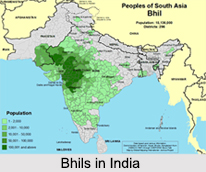
Bhil Tribe
The people of the Bhil tribe are the most widely distributed tribal groups in India.
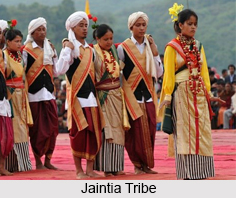
Jaintia Tribe
Jaintia Tribes are located in the Jaintia Hills of Meghalaya. They are also called the Pnars. They are famous for weaving of carpet, making of musical...
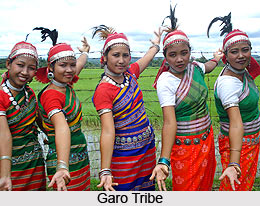
Garo Tribes
Garo Tribes are one of the matrilineal tribes of North-East India who reside in the Garo hills of Meghalaya. Historically, the tribe originated in Tib...
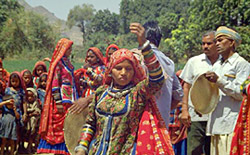
Garasia Tribe
The Garasia tribal community holds a significant position within Indian culture, renowned for their distinctive way of life and rich cultural heritage...