
The thirty-third yoga sutra states about the difference of moments and movements, involving time. As transformations of the gunas cease, time - the incessant movement of moments, stops. These deep-seated contradictions of time can only be distinguished in the later stages of emancipation. An ordinary person is not however, conscious of the moment, he cognises this movement as past, present and future. A perfected yogi dwells in the moment, never getting involved in the movements of moments. Psychological and chronological time comes to a culmination. Dwelling in the moment, the yogi perceives the seer. Nature, since time immemorial has aided consciousness and intelligence towards evolution. And, evolution always takes place in a moment, not in the movement of time.
ksana moments
pratiyogiuninterrupted sequences, corresponding to, related to,
co-operating with, equally matched, counteracting
parinama change, transformation, alteration, expansion
aparanta at the end
nirgrahyah distinctly recognisable, entirely apprehensible, entirely comprehensible
kramah regular process, course, order, series, succession
As the mutations of the gunas cease to function, time, the uninterrupted movement of moments, stops. This deconstruction of the flow of time is comprehensible only at this final stage of emancipation.
The sequence of time is related to the order of movements of the gunas of nature. Only the yogi recognises this inter-relationship and is free from gunas.
The uninterrupted succession of moments is called time. These movements of moments and the uninterrupted mutation of the gunas of nature are distinctly recognisable at the culminating point of transformation.
The average person is not aware of moments - he understands their movement as past, present and future. When moments sup away from one`s awareness, one lives in movements. Memory begins to exert its influence, and consciousness is felt at this juncture in the movements of time.
The perfect yogi lives in the moment without getting involved in movements - the movements of moments are arrested, and psychological and chronological time comes to an end. Living in the moment, the yogi sees the seer. This is evolution. Nature eternally helps the intelligence and consciousness towards evolution (parinama nityan), whereas the seer remains eternally changeless (kutastha nityan). (iv.2i refers to the Mundakopani-sad. The first bird, as seer, was called kutastha nityan as it remained steady and still; the other, as consciousness (panndma nityan) was constantly moving in the effort to reach the first one.)
Evolution takes place in a moment. Moment implies instant while movement implies time. When change comes, it arrives at once in a moment, only after a series of efforts involving movements of time. Transformation does not come without effort. As change is noticeable to an average individual, so the end transformation is distinguishable to a yogi by virtue of his pure wisdom - dharma megha samadhi. He is free from time, place and space, while others remain trammeled in this net. He is neither attracted towards nature nor disturbed by it. He is now a divine yogi. (11.18; 111.13, 15, 53)
Ksana pratiyogl parinama aparanta nirgrahyah kramah
This is the thirty-third yogic sutra, which is contained in the fourth phase of the Patanjali Yoga Sutras.
Recently updated articles in Yoga
Khanda Manda Yoga
Khanda Manda Yoga is a difficult form of yoga where the Yogi cuts off his own arms and legs with a sharp cleaver, that is axe-like knife, and throws t...
Kaivalya Pada
Kaivalya Pada, the fourth chapter of Patanjali Yoga Sutra denotes an absolute, indivisible state of existence of the Yogi. The Kaivalya Pada is someti...
Vibhuti Pada
Vibhuti is the Sanskrit term for “power” or “manifestation.” In this third chapter, Patanjali introduces the final three limbs of Aṣṭanga Yoga, collec...

Sadhana Pada
Sadhana Pada in Patanjali Yoga Sutra denotes the idea of practicing yoga that leads to spiritual illumination. Sadhana, the Sanskrit term for “practic...
Samadhi Pada
Samadhi Pada is the first chapter of Patanjali Yoga Sutra. In this chapter, the author explains the essence of yoga, the nature of samadhi, and the me...
Related articles in Yoga
Cultural Asanas
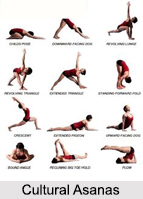
Cultural Asanas refer to the daily physical exercise postures that train the body and mind in Yoga Practice.
Kundalini Chakras
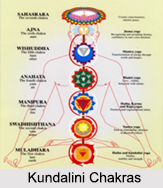
Kundalini Chakras are psychic energy centres or vortices, which connect between our psychic and physical energy systems.
Patanjali Yoga Sutras
Patanjali’s Yoga Sutras presents a foundational guide to the philosophy and practice of yoga. Through concise aphorisms, it outlines the nature of the...
Kubera Mudra
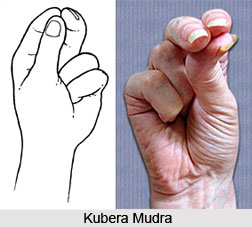
Kubera Mudra, a form of Hatha Yoga, leads to the elevation of mental peace and physical relief by proper practice and cleanses frontal sinuses.