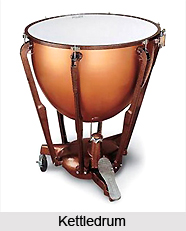
 The kettledrum or timpani is shaped almost like a hemisphere. The basic material used for creating it is usually hand-wrought copper, although other light metals are also used. The kettle has a hole in the bottom to release air pressure and acts as a resonator. The top of the kettle is sealed with an even, thin membrane. This membrane is stretched over a framework consisting of one fixed and one adjustable ring.
The kettledrum can be tuned by adjusting the movable ring, turning the six or eight wing nuts by hand, but it can also be tuned by using the follows:
•A rotary mechanism, by which the timpani is rotated, stretching the drumhead from the center
•A kind of crankshaft, with which the drumhead can be uniformly retuned via a number of tension rods
•A pedal, which makes very reliable and more precise tuning possible using a crown mechanism.
The timpani with the pedal mechanism is the most common type of kettledrum to be found in the modern symphony orchestra. The classic timpani, from which no more than three or four notes are required, is also used quite frequently nowadays for authentic performances.
A distinction is made between the large timpani with a diameter of around 28 inches and the small or piccolo timpani with a diameter of 251 to 254 inches. In addition, there are the bass timpani or large D timpani, with a diameter of 32 inches, and tall timpani with a diameter of 22 inches. The timpani is struck with a range of drumsticks, such as the typical 12-inch kettledrum sticks made of ash whose heads are made of cork or cloth. The timpani is usually struck at a point one quarter of the diameter from the rim. If the striking point is closer to the center, the tone becomes less resonant.
The forerunner of the modern Western timpani comes from Arabia. The nagara is a small kettledrum that is always played in pairs. The body is ordinarily made of clay or wood and the drumhead is stretched taut with a lacework of cords. By twisting a stick in the lacework, the tension of the drumhead can be raised, thus changing the pitch. This percussion instrument is also widely used in India.