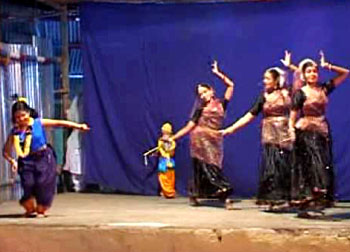
 Kaliyadamana is a popular drama by Sankaradeva. The story of the drama goes such. A mischievous snake by the name of Kaliya lived in a lake called Kalindi. He ruled the domain of water here unchallenged and took pleasure in polluting the lake with his deadly poison. One day some cowherds with their cattle came to the lake to drink water; soon after drinking that water, they were all dead because it was contaminated by the snake`s poison. Lord Krishna, who revived them to life, wanted to punish Kaliya for his mischievous propensities. With this purpose, Krishna entered the lake, whereupon a deadly fight ensued between him and the serpent. The serpent was so powerful that Krishna lay unconscious for some time in his grip. But in a flash, Krishna released himself from his deadly grip, overpowered the serpent and climbed up to the expanded canopy of his thousand hoods. Thereupon he indulged in one of his cosmic dances, the serpent was on the verge of death. Then, remorseful and repentant, the Naga Kanyas, Kaliya`s wives, appeared in the scene and prayed to Krishna to spare their husband`s life. Kaliya too was so impressed with Krishna`s prowess and mystic charm that he fell at his feet. After he was vanquished, the serpent was banished to an island called Ramanaka. The central motif of this play, the story of which is borrowed from the Bhagavata Purana, is Krishna.
There is a sub-plot in the play which is independent of the main story. After the episode with Kaliya, Krishna and the cowherd boys and girls could not return to their respective homes that night; they stayed behind in Vrindavan. At night, there was an accident; a fire broke out and they were engulfed in it. Krishna with his divine power quelled the fire and saved his companions from it.
The Sutradhara plays a dominant role in this play; his individual contributions to the development of the story together with the songs, through dialogues into the side lines. The dialogues are not only few in number, but they are vitally weak also. However, the drama has a symbolic significance. Some scholars have interpreted the conquest of the serpent Kaliya by Krishna as the victory of one cultural pattern over another, i.e., the Aryan as represented by Krishna conquering the non-Aryan as represented by Kaliya. Notwithstanding this, it is a fact that the serpent Kaliya is a symbol of certain baser things of life, viz., pride and false show, intolerance and impiety, things that go counter to the basic tenets of Vaishnava attitude. Krishna`s victory is also symbolic. It is the victory of tolerance over intolerance, compassion over cruelty.