Jain Architecture in South India resembles the Dravidian style. Jainism had reached South India in the beginning of Christian era. Best specimens of Jain architecture can be seen at Shravanabelagola, Mudabidri.
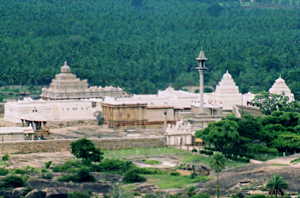
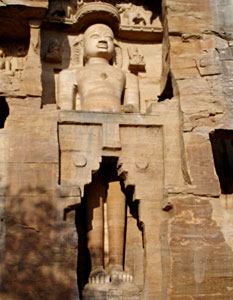
Shravanabelagola is the centre of Jainism in the South. One can see at the peak of Vindhyagiri a 17meter high statue of Gommateshwara that is carved on a rock. He is also known as Bahubali, a son of the first Tirthankara, Adinatha according to legends. Around this statue, there are lot of temples. Chandragiri Hill is much more important as far as architecture is concerned. Mana-Stambha is situated there and there are twelve temples to accompany it. Kattale Basti is the largest and it conveys the characteristics of "Southern Style" especially the Chamundaraya Basti temple.
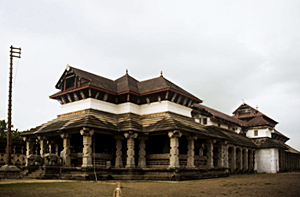
Mudabidri is another holy place in South India for the Jains. This small town has eighteen Jaina temples. In front of each temple a stambha is erected. The temple style in the west coast is different from that of Tamil Nadu. The largest temple in Mudabidri has its upper part made of wood and has a pitched gable roof atop. This "West coast Style" is linked to the state of Kerala.
During the rule of the Rashtrakutas several basadis were erected. Parsvanatha Basadi at Ron is one of the most important one that has exquisitely carved grills that depict Gandharvas in scroll work. The Jaina architectural beginnings made by the Kadambas of Banavasi were transformed into better stone structures during the period of Badami Chalukyas. The 4th cave is the Jaina cave that is dedicated to Adinatha Tirthankara.
Aihole has Jaina cave temple that is an open mandapa and a Sabhamandapa. The Garbhgriha has the sculpture of Mahavira in Padma Sana. Other Jain temples include Meguti Jinalaya at Aihole; Sankha Jinalaya at Lakshmeshwar is dedicated to Neminatha, Jinalaya at Hallur, Jinalaya at Adur in Hangal taluk. The Jaina monuments that were built during the period of Rashtrakutas are found at Pattadakal, Malkhed, Lakshmeshwar, Koppal, Bankura, of North Karnataka. The Neminatha basadi at Malkhed is another example of Jain architecture. Other sculptures are those of Parsvanatha, Dharanendra and Padmavati. Jaina temple at Naregal has a sikhara of Dravida vimana type over the Garbha griha. Jaina basadi at Konnur in Dharwad District was built during the period of Amoghavarsha I and it has a star shaped Garbha griha.
Settavva temple at Aihole is another basadi. Fine notable sculptures are Adinatha, Chandraprabha, Santinatha, Parsvanatha, Mahavira and Padmavati. The most important Jaina temples of this period are: Brahma Jinalaya at Lakkundi, the Brahma Jinalaya built by Attimabbe, Sankha Jinalya at Lakshmeshwar.

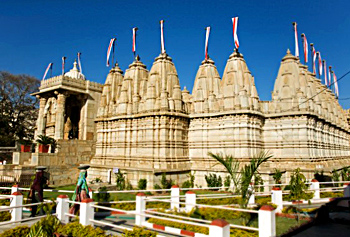
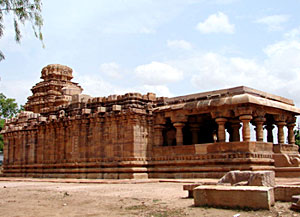 Jain architecture in India is found in Jain temples of states like Karnataka, Rajasthan and Maharashtra. Mount Abu is considered as the finest specimens of Jain architecture. Jain architecture has an origin in its own style which is considered as more Turanian. The main feature of Jain buildings is the horizontal archway. The bracket form of capital was also introduced in Jaina buildings for the first time in Indian architecture.
 The Aiwalli temple in Dharwar, in Western India has the ground plan of the Jain temples. This is identical with the ground-plan of the structural chaitya at Sanchi Stupa. Jain temple covers an image to which the worshippers must have access. There is a thickening of the apsis wall in order to carry the tower that marks the position of the image. The neighbouring Jain temple at Pittadkul which was built two centuries later, it is seen that the cell has become the base of a square tower. The nave of the chaitya has become a well-defined porch but distinct from the cell and these two features are the essential elements of the plans of Jaina temples of subsequent years.
 Tower or Vimana is a major feature of Jain Architecture in North India. Two most important towers in Chittorgarh reveals the basic Jain architecture: Kirti Stambha" (Tower of Fame) and the other is called "Jaya Stambha" (Tower of Victory). The tower has seven stories on the basement. The top floor is an observation hall from which one can have a view of the inside the citadel, surrounding plains and the horizon. It is dedicated to the first Tirthankara (Jina) Adinatha. Its formation is unique. It has complicated formations: it is covered with carvings of the statues of Jina, has a streak of combination of narrow and thick parts and shaded by positions and balconies.