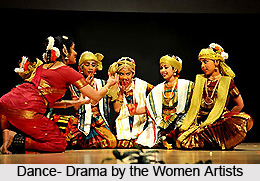
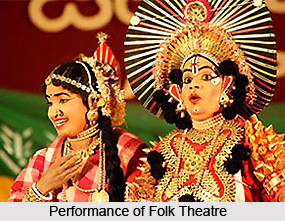
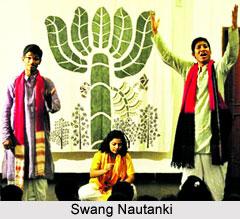
 History of Swang is traced to Kishan Lal Bhaat, who some two hundred years ago, is said to have laid the foundation of the present style of folk theatre. The community life of late medieval North India was enlivened by a number of performance traditions of a mainly local and oral character. Many of these arts, including those of a theatrical nature, went into eclipse during the period of cultural redefinition and reform that occurred in the late nineteenth and early twentieth centuries. More recently, shifts in historical method, together with cultural and political processes at work in India have stimulated a reassessment of the pre-modern cultural landscape and sparked an effort to restore it to Indian social history.
Before the twentieth century the theatre, now identified as Nautanki, was known as Swang. This term is still used to refer to the art of mimicry and impersonation in general as well as to specific skits. The word Swang and its variant sang are related to sangit, a term employed from the mid nineteenth century onward as a generic marker for the libretto or musically rendered dramatic script. "Nautanki," originally the name of a heroine and the musical stage play based on her story, came into wide parlance replacing the term Swang around 1920.
"Swang" is even now the label applied to the Nautanki among scholars of Indian theatre.A recognisable Swang folk theatre appears in the mid-nineteenth century Sangit texts, lodged in the India Office and British Library collections. Early dramas, like, Prahlad Sangit and Gopichand Raja Ka Sang contain the thematic and metrical seeds that later flowered into the full bloom of the Hathras and Kanpur styles of Nautanki. Scholars in India have shown some reluctance to push the theatre`s historical narrative further back.
The predominant opinion is that drama was sadly missing for the many centuries between the decline of Sanskrit theatre around A.D. 1000 and the appearance of nineteenth century urban drama. Collating information from a variety of colonial, literary, and ethnographic sources, it has been established that the Swang stage constituted an incremental development in a pre-existing arena of public entertainments, influenced both by evolving folk traditions and by court-based and urban performance styles.