Skate Boarding
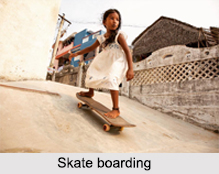
Skate boarding one of the emblematic sports of the recent era is a competition between two or more skaters.

Share this Article:

About Skate Boarding

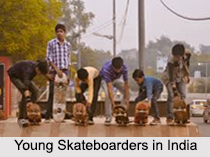
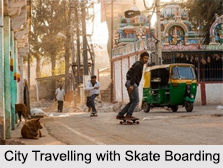
Skate Boarding, Adventure Sport in IndiaSkate Boarding is among the most famous sports in Europe and America, and has quite a number of competitions that have been played in several parts of the world. It is now becoming popular in urban Indian states like Delhi, Jammu and Kashmir and Uttar Pradesh. The most popular among them is probably the X-Games. Though each of the competitions has its own rules and regulations, there are some similarities in their playing procedures.

Big Air : When the Selection Session of this Skate Boarding tournament is going on, nine skaters will take four jumps each. Their main object is to earn one of the three spots in the Finals where they will compete with the best three skaters of the previous year`s tournament. Each of the six skaters takes five jumps in the Finals. The skater who has got the highest score wins the tournament. This is not a timed competition and it is mainly judged based on the style, creativity and amplitude of the skaters.

Street Men`s : In the Selection Session for Street Men`s 19 skaters take part. Among them, only 9 skaters will be allowed to participate in the finals. The skater who got the first place from last year`s competition will automatically qualify for the finals and make the number of competitors count as 10. The Finals of this tournament normally divided into three fifteen-minute sessions. The judges will rank the riders from 1-10 at the end of each session and then assign each of the riders a score from 1-100. This assignment of the scores will be based on aggressive execution of manoeuvres. The different parts of this execution are: content - the number, difficulty, originality and variety of tricks that the skater performs successfully; style - the fluid linking of individual skater`s tricks; and the use of the course and course obstacles such as ramps, boxes, handrails, etc. by the skaters. Each skater has the liberty to hit the feature as many times as he chooses within the allotted time. After that, the judges will again rank the riders from 1-10 and assign each rider a session score from 1-100. The total score of a rider from the three sessions are divided by three to give an overall score to each of the skaters. After all the calculations, the skaters are ranked as 1-10 on the Final`s leader board.Skate Boarding, Adventure Sport in India

Street Women`s : The Street Women`s contest usually follows almost the same format and procedures as the men`s. However, there are some little changes in this tournament. They are: there is no selection session here, the number of competitors is eight and the duration of the three sessions decreased to only seven minutes.

Vert Men`s : Here, the total number of the competitors is 10. Each of them takes three different 45-second runs. The best score amongst the three will serve as the final score for the standings. The judges will judge the competitors based on their aggressive execution of manoeuvres, degree of difficulty, variety, continuity of run, originality and style, amplitude, height of airs, length of grinds and use of the ramp.

Vert Women`s : In this type of competition, eight skaters take part in a 30-minute jam session and the judges normally judge them based on the originality, variety and difficulty of the manoeuvres that they have performed. The judges rank them from1-8 at the end of the session.
Skate Boarding, Adventure Sport in IndiaAmong the types of competitions that have been discussed above, the `Big Air` is the newest addition. This competition features the athletes skating down a 60-80 foot high roll-in. Here they choose to launch over a gap of 50 or 70 feet long and continue into a 27-foot quarter-pipe. The Skate Board legend Danny Way developed this discipline and it is showcased exclusively at the very famous X-Games. The Street competitions usually showcase the skaters performing tricks in an existing concrete plaza that is completed with stair sets, banks, manual pads and ledges. In the Vert competitions, the skaters usually compete on 120-foot wide ramp that is completed with 11-foot transitions and two feet of vert. In fact, Skate Boarding is a competition between two or more skaters.

History of Skate Boarding

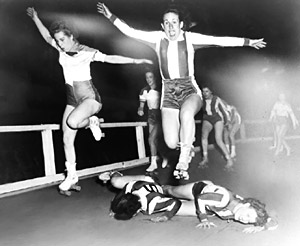
Roller DerbyThe sport named as Skate Boarding is amongst the most famous sports in the European Countries and also in America. This exciting sport is quite popular in the other parts of the world as well. Though, the sport is not that much old in age, it is claiming its spot in the minds of adventure loving people very quickly. To talk about the history of Skate Boarding, there is a big question about the exact timing of the game`s invention. The main aspect of the game is the Skate Board. According to some people, this Skate Board was first invented as a kind of homemade scooter that was designed with roller-skate wheels. Initially, these wheels were attached with a milk crate that was standing vertically at the front and formed one type of handle. The handle was removed within a few days and it took the formation of a Skate Board.

However, to some other people, the story of the Skate Board is a little different. They say that, the surfers who needed a way to surf when the waves were flat invented the Skate Board. At that period, people used to call Skateboarding as "sidewalk surfing". The name was evident as the early skaters followed the moves and style of surfing. In spite of having so many controversies about its innovation, the Skate Board was able to keep only one design for it. The standard design was a 2X4 Board attached with roller-skate wheels. After being played as a park play for several years, the homemade Skate Boards got the first commercial attention in the later half of the fifth decade of last century. In the year of 1959, the first Skate Board that came to the market for sale was the "Roller Derby". As the relation between the surfing and the Skate Boards was evident, the surfers made a huge use of these Skate Boards in order to practice their skills. This is another strong reason behind the belief that it is the surfers who originally invented the Skate Board.

When the "Roller Derby" became very much successful commercially, there came some other companies in the market with their innovative ideas of the Skate Board. The Hobie and Makaha introduced the plastic Skate Boards and for these easily affordable Skate Boards, the game of Skate Boarding started its journey to be played in the competitions. The first International Skating Championship was held in the year of 1965. In the same year, the first skateboard magazine named as "The Quarterly Skateboarder" was also been introduced. The International Championships were broadcast on national television. It was this year when the game of Skate Boarding went mainstream. However, from the very following year the popularity of Skate Boarding started to drop down.

Though Skate Boarding almost disappeared from the public view during the late 60`s, the decade of 1970 brought a great light of hope to the world of Skate Boarding. In the early 70`s, a man named as Frank Nasworthy discovered a new material, Urethane and began to make Skate Board wheels with this material. As these wheels were quite superior to the clay wheels in every aspect and were soft enough to roll over defects in riding surfaces, the traction and performance was improved a lot and this made a great hike in the popularity of the sport of Skate Boarding. This hike in the popularity attracted a large number of manufacturers to invest in this sport and these investments gave the Skate Boarding a great technological breakthrough that was needed. With this breakthrough, the modern outdoor concrete skateparks also began to come into existence. Amongst them, the first that was opened for business was in Port Orange, Florida. This changed the dimension and characteristics of the game in a great way.

After the popularity increased, more and more tricks of the game were discovered and in order to do them more easily, the Skate Boards got wider. They became 10 inches in width and some other new parts like trucks were attached with the Boards. When the skinny, plastic yellow coloured boards came into the market, the very famous term of "Banana Board" become obsolete. There were some kinds of renovation in the design of the Boards going on at that time as well. However, the maple plywood Skate Boards proved to be the best among all the renovations as it has the perfect spring, flexibility and the crispness needed for Skate Board tricks and exercises.

Skate Boarding - 1977When the Z-boys and others invented the tricks to skate vertically in the year of 1976, it started a brand new trend in the world of Skate Boarding. The vert Skaters began to skate faster and perform more risky tricks as the slash grinds and front or backside airs and these new adventurous tricks boost up the popularity of the Skate Boarding in a great way. The game began become a phenomenon during the later part of the 70`s. It got immense popularity in the National level and thousands of skate parks started to be situated. However, because of some unfortunate reasons like the hike in the insurance rate of the skate parks, forced the game to fall in crisis for the second time at the beginning of the 80s.
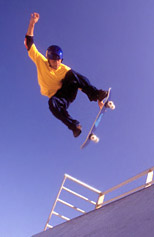
The game of Skate Boarding again recovered from the crisis by the mid to late 80`s. During this time some incidents helped the game to be amongst the popular games once again. Some new Skate Boarding publications started to be published, new manufacturers appeared in the market and the "streetstyle" Skate Boarding gave the sport a renewed enthusiasm. The National Skateboarding Association started to organise contests and championships across North America and then throughout the world. The final evolution of the design of the Skate Boards and skating tricks and maneuvers were also marked down during this time. The Board design was standardized to a 7-ply, pressed maple laminate that evolve to a point in shape.

The decade of the 1980`s also brought some great changes in the tricks and ways of Skating. From that time, the first and foremost focus of the game became to ride larger vertically. The "U"-shaped ramps were being made to do it more easily. Not only this, vertical Skate Boarding began to focus on the aerial maneuvers as well. As this was quite a difficult task to do so, this increased the number of spectators in the game of Skate Boarding. A new type of Skate Boarding also emerged in the late 80`s. This was named as the "Street Skating". Another form of Skate Boarding named as "Freestyle" emerged almost at the same time. The Street Skate Boarding was being performed on the vert-style boards even after being very much popular. However, the evolution of Street Skate Boarding lead the way to the current state and design of Skate Boards used in today`s world. These Boards are trademarked by long noses and lightweight capabilities.

After having such a great decade of the 1980`s, the game of Skate Boarding again turn down shortly in the early period of the 1990`s for some unavoidable reasons. In the year of 1991, the game faced a worldwide collapse. As a highly technical version of Street Skating, combined vert skating produced a new sport that lacked the mainstream appeal to attract new skaters, only a small fraction of skateboarders remained by the year of 1992. However, despite these setbacks, skateboarding didn`t die another death. It was preparing to reinvent itself once more.

During the mid 1990`s, the game of Skate Boarding once again recovered the collapse. The National Skateboarding Association became World Cup Skateboarding (WCS) in the year of 1993. It started to conduct professional tours with events in the countries like United States, Canada, England, Germany, Czech Republic, France, Switzerland, Austria and Brazil. Another organization, named as the United Skateboarding Association (USA) was also founded in 1998 with a view to conduct competition in the United States. As a result, the game reached a large number of audiences in every country of the world through the satellite TV and the events like the Extreme Games (Popularly known as the X-games). With the help of these incidents, the game of Skate Boarding enjoyed new levels of popularity up until the end of the century. It also enjoyed its own global renaissance in accordance with the increased globalisation of the world at large. An international audience of the game was evolving and new talents and professionals from all over the world were also brought with this global audience.

In the new millennium, the game of Skate Boarding became more and more popular among the world audience. The popularization of Skate Boarding video games such as Tony Hawk`s Pro Skater along with the X-games contributed a lot in making this new era of Skate Boarding. In today`s world, among the numerous cities having the skate parks, the Vancouver, Canada is well known for its multitude of skate parks and can even be called as the "Skatepark Capital" of the world. However, the skateparks have also gone through some changes in recent times. Among the changes, the "Skate Plaza" should be counted as the foremost. This is in fact in the theory of a skatepark but have the look of a normal public park. In such a park, one can easily find the real sidewalks, real benches, real stairs, and real handrails to skate upon.

From the discussion above, it is quite evident that. The game of Skate Boarding has a very much fluctuating experience throughout its existence. Sometimes it went up in the popularity and sometimes it collapsed almost to the death. However, despite of all its ups and downs, the game has been able to remain amongst the top most popular games of today`s world and there is no sign for it to collapse again in the very near future.


Terms of Skate Boarding

Terms of Skate Boarding on airThere are quite a few terms and vocabularies in the game of Skate Boarding that include certain aspects of the game like the Skate Board, the skating tricks and also the obstacles. As the game is very simple and easy to play, the terms of the game are very limited. The terms of the game of Skate Boarding are:
Basic Terms:
Deck: `Deck` is the flat standing surface of a Skate Board used by a skater. A grip tape usually covers it. This tape provides the skater a place to stand.
Grip Tape: This term identifies the sandpaper that is fixed to the top of the `Deck`. This is used in order to increase the traction or friction between the Skate Board and the skater`s feet so that they can easily keep a grip on the board.
Nose: This is the front side of the Skate Board. The area of the `Nose` is from the front truck bolts to the end.
Rail: The term `Rail` means the edge of the Skate Board. It can also be used to indicate the plastic strips that remain attached to the Board`s underside.
Tail: This is the bottom of the Skate Board that usually covers the area from the back truck bolts to the end.
Trucks: The front and back axle assemblies of a Skate Board are known as the `Trucks`. They usually connect the wheels to the deck and allow them for turns.
Wheels: One of the two most important parts of the Skate Board, the `Wheels` are made of polyurethane in general and got the size of between 39 and 66 millimeters in diameter. The skaters usually measure their hardness by using the udometer, a number that ranges from 0 to 100. The soft wheels are measured by the udometer of about 85 and the hard wheels have a udometer of 97 or higher.
Wheel Base: This term indicates the distance between the front and back wheels. The `Wheel Base` is normally measured between the two sets of innermost truck holes.

Terms About Tricks:
Air: This term means a trick of the skater where he rides in the air with all the four wheels remaining off the ground. This is a special trick and needs a lot of practice to do.
Backside: This term indicates about a trick or turn. In this trick, the skater`s backside remains to the ramp.
Caballerial: This special trick is named in the honour of Steve Caballero who invented this. In this trick, the skater performs a 360-degree turn on a ramp while riding the `Fakie` (backwards).
Carve: This trick means to skate in a long, curving arc. Here the skater pushes one side of the edge towards the ground.
Fakie: When a skater stands in his normal stance but moves the board continuously, then the trick is called as `Fakie`.
Front Side: This is the area where a skater does a trick or turn with his body facing the ramp or obstacle.
Goofy Foot: When a skater rides the Board with his right foot forward that is the opposite of his "regular foot".
Grind: The term `Grind` means to scrap one or both axles of the Board on a curb, railing, or other surface.
Crooked Grind: In the `Crooked Grind` trick, the skater grinds on only the front truck while he is sliding.
50-50 Grind: In this trick, the skater grinds equally on both the trucks.
Nose Grind: The skater grinds on only the front truck when he is performing the trick named as `Nose Grind`.
5-0 Grind: Here, the skater grinds on only the back truck.
Kick Flip: This trick has some similarity with the `Ollie`. If the skater kicks the board in such a way that it spins before landing back on it, then he is performing the `Kick Flip`.
McTwist: This is a special trick where the skater turns to 540-degree on a ramp. This trick was named after Mike McGill.
Mongo Foot: This is a style of pushing the Board where the back foot of the skater is kept on the board and he does the pushing with his front foot.
Nollie: When the skater taps the nose of the Board rather than the tail, he is showing the trick named as `Ollie`.
Nose Slide: This term indicates about the trick where a skater slides on a ledge or lip with keeping the nose of the board pressed against.
Ollie: This is a jumping trick performed by the skater where he taps the tail of the Board on the ground.
Rail Slide: In this trick, the skater slides on the bottom of the Deck along with an object like a curb or handrail.
Regular Foot: This term means the trick where the skater rides with keeping his left foot forward. This is the opposite trick of the "Goofy Foot".
Shove-it: When the skater spins the board 180 degrees beneath his feet while moving forward, he is performing the trick named as `Shove-it`.
Switch Stance: If a skater rides the board with his opposite footing than usual, then it will be referred as a `Switch Stance`.
Tail Slide: In this trick, the skater slides the bottom of the tail on a ledge or lip.

Some Obstacles:
Street Skating: This term identifies one of the kinds of skating. Here, the skaters skate on the streets, curbs, benches, handrails and on other elements of urban and suburban landscapes.
Vert Skating: In this type of skating, the skaters skate on ramps and other vertical structures that are designed for skating.
Half Pipe: This is a U-shaped ramp where the skaters perform. This can be made of any size.
Vert Ramp: This term means a `Half Pipe` that is usually at least 8 feet tall. It has some steep sides that become vertical at the top.

The terms of Skate Boarding that have been discussed so far are the most general terms. However, there may be some differences in these terms as well depending on the different states and countries where the game is being played over the years.


Rules of Skate Boarding

Skate BoardingBeing among the most famous and popular sports in Europe, America and all over the world, the Skate Boarding is such a strange game that does not have that much rules and regulations like most of the other sports. The reason behind this is probably that it is a freestyle sport, mainly based upon the innovative performances of the skaters. However, this is not without any rules as well. There are some rules that govern the Skate Boarding. The rules are as follows:

Rules:
According to the basic rules of the game of Skate Boarding, usually more than two skaters take part in a competition. After the selection process of a competition is done, the selected skaters participate in the final stage of the tournament. To start the finals of a tournament, the first skater attempts his own trick. If he lands properly after completing his performance and the judges consider it as an acceptable landing, then all the other skaters will have to do exactly that same trick. If any skater fails to do the trick properly and his landing is reckoned as unacceptable, then the judges will give him a letter from the word "SKATE". As "S" is the first letter, the skater will be given this letter for the first failure. He will get "K" if he fails for the second time and "A" for the third time. The judges will be giving the letters to the skater one after another for each of the faults of the skater. The will continue to give the letters until the word "S-K-A-T-E" is totally spelled out. The skater who gets the whole word "SKATE" is considered as eliminated from the tournament.

When all the players complete their attempts on the first players trick, the first player attempts a different trick. If he again lands properly and complete the trick successfully, then the judges repeat the entire process. However, in the case of the first player missing his trick and failing to land, the second player gets the chance to attempt a trick. If the second player lands his trick properly then all the other skaters have to attempt and complete that same trick. In this case also, if any of the skaters fails to land properly and the judges consider this as unacceptable, then he gets a letter from the word "SKATE".

From the discussion of the basic rules so far, there may arise some questions in the reader`s mind about these rules. If anybody asks about whether a skater has the chance to do the same trick twice, then the answer will be in negative. No skater is allowed to do this. However, all a skater can do is to learn and practice a trick as soon as he can. He has the chance to do a trick in a different posture. If it`s still hard to understand then here is an example: When a skater does a `Kick Flip` trick the other skater can do a `Nollie` or `Fakie` or `Ollie` when he gets his turn. He can also change to `Kick Flip`.

Among the general spectators of the game of Skate Boarding, some people think that when a skater is performing, all he has to do is perform or attempt a trick better than the trick performed by some other skaters before him. However, that`s not the truth. There is another question that arises in the mind of people about the Skate Boarding. The question is about how long a skater should hold a trick. It can be said in reply of this question that, there are different views about this rule. Some people think that a skater should ride away clean for about 3-4 seconds while skating. However, some other people don`t like this rule. Anyway, whatever the disparities about the rules of the game are, overall "Skate Boarding" is really a very funny and interesting way to compete and play with friends and also to show off someone`s personal skills in Skate Boarding. The game can also be used in order to increase one`s fitness level.


Share this Article:

Related Articles

More Articles in Athletics in India


History of Indian Athletics
India enjoys a long history of athletic sportsmanship from the Vedic era to the modern period, and is now actively involved in contemporary forms of athletics.
Sqay Martial Arts
Sqay is a martial art form from Kashmir. Sqay is a Persian word which means `knowledge of war`.
Throwing Events
Throwing events are a part of Olympic and Commonwealth events and go back a long way in history. The throwing events in India came in the limelight after the Second World War.
History of Badminton in India
The history of badminton in India dates back to the mid-18th century when it started to gain popularity in erstwhile Pune.
Gachibowli Indoor Stadium
Gachibowli Indoor Stadium, in Telangana, hosts a number of indoor sporting events like table tennis, boxing, judo, weight lifting and many more
Malathi Krishnamurthy Holla
An international para athlete, Malathi Krishnamurthy Holla is a recipient of both the Arjuna and Padma Shri Awards.
Dronacharya Awards
Dronacharya Award is the prestigious and honourable awards that are being given by the Government of India to the successful Sports Coaches.
Mountaineering in India
Mountaineering in India is popular in the Himalayan and Eastern Karakoram ranges.
Arjuna Awardees in Athletics
The field of Athletics has almost dominated the winners` list of the very much prestigious and honourable "Arjuna Award"
Sambhaji Kadam
Sambhaji Kadam is an Indian basket ball player who competed in FIBA Asia Championship in 2007.
Indian Volleyball Players
Indian Volleyball Players won laurels for their nation from the time of independence of India. Some of the players are proud recipient of Arjun Awards too.
Indian Athletes
Indian Athletes includes those individuals who have made their mark in the international scene with their talent and athletic endeavour.
Gymnastic in India
Gymnastic in India is funded and well supported by Gymnastic Federation of India (GFI). The federation plays a pivotal role in promoting gymnastics in India. Gymnastic in India is now becoming popular after Dipa Karmakar won the bronze medal in the Gymnastics at the 2014 Commonwealth Games - Women`s vault.
Girisha Hosanagara Nagarajegowda
Girisha Hosanagara Nagarajegowda is an Indian athlete born with disability won several accolades in several national and international tournaments.
Handball in India
Handball in India with its entire verve has earned the status of one of the most sought after sports in the country. Handball is concentrated in Andhra Pradesh, Uttar Pradesh, Haryana, Vidharbha and Jammu and Kashmir.
Indian Basketball Players
Indian Basketball Players have shown great performances in several international basketball tournaments, including the Olympic Games. Though it is not popular like football and cricket, basketball needs world-class infrastructure to promote new age aspirants.
Indian Martial Arts
Indian Martial Arts exhibit great variety in their form and style. In modern India, martial arts have become one of the necessities especially for girls. Different regions of the country have different martial art forms, which have contributed towards the richness of this art form.
Indian Golf Players
Indian Golf Players in the recent years have brought laurels to our country by winning some of the major international golf titles. The most successful Indian golfers in India are Jeev Milkha Singh and Anirban Lahiri.
Indian National Basketball Team
Indian National Basketball Team is representing men’s section in basketball championships.
Pole Vault
Pole Vault is a part of Olympic event since 1896. Pole Vault is in recent times gaining popularity for the best performances of V. S. Surekha, Karamjit Kaur and Dhirendra Kumar.