
The Gharana tradition, as one understands today, evolved in North Indian Classical Music during the 19th century and the early part of the 20th century, primarily in the ambience of certain royal courts of the native states in Central and North India. A Gharana represents a distinctive musical style or idiom, founded and perpetuated by an outstanding artist or an assemblage of great artists. The distinctive features of the Gharanas have been the subject of considerable scholarly attention.
Gharana styles are classified on a continuum defined by rhythmic direction and melodic orientation as the two divisions. Amongst the Gharanas considered the Agra is placed at the rhythmic orientation division and Kirana at the melodic orientation polarity. At the exact mid-point of the continuum, Alladiya is placed as a complex fusion, and Gwalior as a simple fusion of the two orientations. Patiala is placed towards the melodic orientation pole, but considerably short of Kirana. The Indore/ Bhindi Bazaar Gharana of Ameer Khan fall between Patiala and Kirana.
Thus the budding of the Khayala genre in various shades symbolized by musicianship in all the Gharanas, made it possible for the century preceding India`s Independence in 1947 to be described as the "Golden Age of Hindustani music."
The Gharana system was incapable of sustaining the blooming of true genius and forced it to seek a diversity of exposure in search of its own voice. This phenomenon suggested that stylistic loyalty to a single gharana was no guarantee of quality musicianship and could, indeed, be an inhibitor of exceptional potential in so highly individualistic an art as Hindustani music.
The momentum of homogenizing forces in the musical culture was greatly enhanced by the appearance of the radio and the gramophone record in the early years of the twentieth century. The electronic media ended the isolation of the different gharanas from each other by making the music of every musician accessible to every other musician and aspirant to musicianship. These media also enlarged the market for art music.
However, even before this development, independence and the launch of a parliamentary democracy had demolished the wall of the Gharana system - the feudal aristocracy.
Democratic India forced musicians to migrate from the smaller towns to the big cities. Heredity, already abandoned as the exclusive entry criterion, gave way to a talent-based selection system for grooming.
Golden Age of Hindustani Music
Golden Age of Hindustani Music refers to the development of the different styles of Gharanas in the pre independence period.
Recently updated articles in Music in India
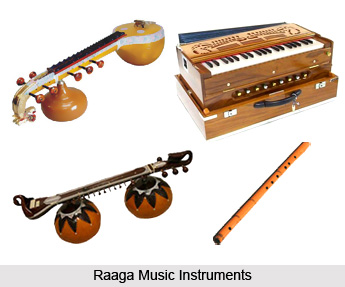
Classification of Raagas in Carnatic Music
Classification of Raagas in Carnatic music is based on scale type, devised as a system for raagas that existed as well as those that were in the proce...
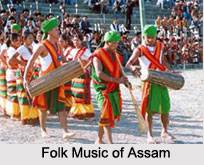
Folk Music of Assam
Folk Music of Assam reflects the outdoor and indoor life of the folk people and it does not follow any strict rule of composition and performance. Fol...
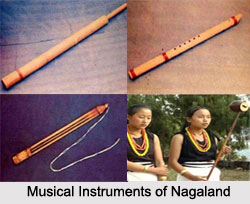
Musical Instruments of Nagaland
Musical Instruments of Nagaland reflect its rich tribal heritage and deep cultural roots. Crafted from natural materials like bamboo, wood, and animal...

Rasa, Hindustani Music
Rasa is an important part of Hindustani Music. Here the creative experience of the artist i.e. musician and the aesthetic response of the connoisseurs...
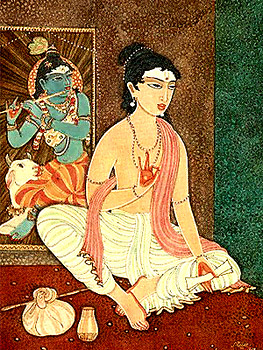
Kshetrajna, Telugu Poet and Composer
Kshetrajna (1600 - 1680) was a creative Telugu poet and composer of Carnatic music. He composed several padams and keertanas.
Related articles in Music in India
Kriti Carnatic Music
Kriti refers to one of the most widely used genres of Carnatic music. It originated from the kirtanas of the bhaktas, i.e., musicians who expressed th...
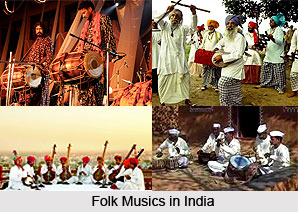
Indian Folk Music
Indian Folk Music is full of rustic charm. The appeal of Indian folk music lies in the simplicity of its style and lyrics. Most of the folk songs are...
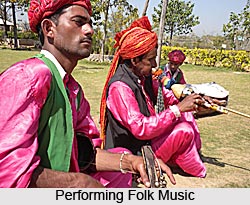
Haryanvi Music
Haryanvi music is the folk music of the state of Haryana and is sung in western Uttar Pradesh along with the neighbouring districts of Rajasthan and P...
Carnatic Music
Carnatic music, also known as `Karnataka Sangitam`, is one of the two styles of Indian classical music.