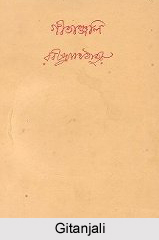
 Gitanjali an illustrious work by Rabindranath Tagore echoes the true Indian Philosophy. This memorable piece of work is actually to address the rich to serve the poor than serving God. When India was under the British rule, Tagore, with the team leaders Gandhiji and Nehru, awakened the Indians through his speeches and works. At that time in many of his works reflects the same- voice against British.
Gitanjali`s rise to fame
His short stories were published monthly in a friend`s magazine and he even played the lead role in a few of the public performances of his plays. At that time he was 51 and was accompanied by his son. On the way over to England he began translating, for the first time, his latest selections of poems, Gitanjali, into English. Almost all of his work prior to that time had been written in his native tongue of Bengali.He decided to do this just to have something to do, with no expectation at all that his first time translation efforts would be any good. He made the handwritten translations in a little notebook he carried around with him and worked on during the long sea voyage from India. Upon arrival, his son left his father`s brief case with this notebook in the London subway. Fortunately, an honest person named Rothenstein took help of his friend W. B. Yeats, and finally published the book. The rest is history. It happened in 1912 and in the year of 1913 Rabindranath Tagore received the Nobel Prize.
 Synopsis:
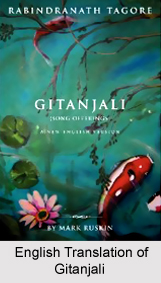
Gitanjali is a collection of English poems and this is the translated version of Bengali poems by Rabindranath Tagore. This collection of poems is very famous in the west. Gitanjali was first published in England in 1912. This English volume, although it shares the name of one of Tagore`s earlier volumes of Bengali verse, is actually comprised of poems from several of Tagore`s previous volumes of Bengali poetry. As a result, scholars have been unable to trace the origins of most of the poems in the English Gitanjali. In addition, Tagore heavily altered the structure and also the content of the poems when he translated them into English. Because of this, it is appropriate to use the year 1912 for the purpose of dating the poem`s creation. A year later, Tagore made history by becoming the first Asian to win the Nobel Prize in Literature. Westerners were initially enamoured of Tagore`s poems for their peaceful, mystical qualities, which contrasted sharply with a world on the verge of a harsh, global war. "60," which features children playing on universal seashore always contrasts metaphysical and religious ideas with the human world to demonstrate the blissful ignorance of children. These children never know about the adult world. The poem also emphasizes the idea of unity, underscoring Tagore`s lifelong goal to unite Eastern and Western traditions. That was a challenge at the time in British controlled India. Generally speaking, Bengali readers know Tagore for his huge body of work, while many Westerners still associate Tagore only with Gitanjali. This novel should read by a ruler, a citizen, a fighter, a religious person, and all of them can know their proper duty after reading this novel.
A current copy of Tagore`s "60" can be found in the latest paperback English edition of Gitanjali, which was published by Scribner Poetry in 1997.