
Dhrupad is one of the most ancient forms of North Indian Classical Music. Dhrupad gharanas had spread to other families in various parts of the country, upholding their ancient culture, some of them also tracing their line to Tansen. And the sheer versatility of the few families, like variations in rhythmic artistry, or dhrupads, sung in honour of the Almighty, gave the gharana even more impetus to continue in their musical pursuit. Some of them also resort to Islamic chants in their tradition.
Some of the remarkable dhrupad gharanas are the Darbhanga tradition of Bihar, represented principally by the Malik family, who trace their origin to Tansen`s lineage. The founders of this style were Radha Krishna and Karta Ram, who were followers of the Gauhar-bani. For generations, they were court musicians in the Darbhanga court.
Unlike the Dagar gharanas, which use natural voice, the Darbhanga singers` recourse to a more stylised mode of voice production. Also, they lay accent on the rhythmic aspect of the composition in their singing. The rhythmic variations and permutations they offer are brilliant. The leading singers of this style comprise the late Ram Chatur Malik, Siyaram Tiwari, Abhay Narayan Malik and Vidur Malik.
Dhrupad Gharanas
The gharanas in dhrupad constitute much significance in their respective styles of rendition.
Introduction
Dagar Gharana
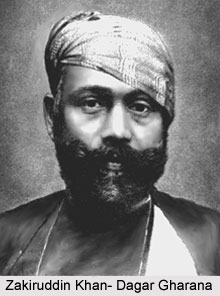 Dagar Gharana is the oldest gharana of classical dhrupad. It was found by Nayak Haridas Dagar in the sixteenth century. Its descendants converted to Islam during the eighteenth century. Major contributions to the upkeep of the Dagar tradition came from Rahim Fahimuddin and Hussein Sayeeduddin, as well as the grandsons of Zakiruddin Khan who revived the majestic Rudra Veena as a concert instrument. In recent times, its most eminent representatives have been vocalists, Nasir Moinuddin Dagar and Nasir Aminuddin Dagar and the bina maestro, Zia Mohiuddin Dagar.
Talwandi Gharana
Apart from the Dagar gharanas the Talwandi tradition also demands attention. It is associated with the western parts of India, specifically with Punjab. Prominent singers of the tradition include Muhammad Hafiz Khan and Muhammad Afzal Khan.
Darbhanga Gharana: Amongst two of the living Dhrupad gharanas Darbhanga tradition is one, apart from the Dagar tradition. Darbhanga Gharana of dhrupad is represented by the Mallik family. Karta Ram and Radha Krishna who were once the court musicians for the Nawab of Darbhanga, are considered the founders of the tradition. Starting with the alaap and then singing the main composition, distinguished the performance of the Darbhanga Gharana of dhrupad singers. Rhythmic aspect is emphasized in this tradition. Famous singers of this gharanas include the late Ram Chatur Mallik, Vidur Mallik, Abhaya Narayan Mallik, and Prem Kumar Mallik.
Bettiah Gharana
This gharana was founded in the seventeenth century; but it mainly flourished during the nineteenth century. It exercised great influence over Dhrupad in the entire eastern region. Musicians of Bettiah are believed to have taught the founders of the once influential Bishnupur gharana in Bengal. Bettiah is represented, on the contemporary concert platform, by Indrakishore Mishra.
Darbhanga Gharana
This gharana was founded in the eighteenth century by two brothers, Radha-Krsna and Karttaram, whose descendents have carried the "Mallik" surname. In the post-Independence era, the most distinguished musicians of this lineage have been Ramchatur Mallik and Vidur Mallik.
Mathura Gharana
This is the oldest gharana of Ha veil Sangita, the dhrupad tradition of the Vaisnavite temples. Though its members have stepped out of the ecclesiastical environment for a nominal presence on the concert platform, their art has not made a complete transition to the elaborate format of contemporary dhrupad.
Recently updated articles in Music in India
Classification of Raagas in Carnatic Music
Classification of Raagas in Carnatic music is based on scale type, devised as a system for raagas that existed as well as those that were in the proce...
Folk Music of Assam
Folk Music of Assam reflects the outdoor and indoor life of the folk people and it does not follow any strict rule of composition and performance. Fol...
Musical Instruments of Nagaland
Musical Instruments of Nagaland reflect its rich tribal heritage and deep cultural roots. Crafted from natural materials like bamboo, wood, and animal...

Rasa, Hindustani Music
Rasa is an important part of Hindustani Music. Here the creative experience of the artist i.e. musician and the aesthetic response of the connoisseurs...
Kshetrajna, Telugu Poet and Composer
Kshetrajna (1600 - 1680) was a creative Telugu poet and composer of Carnatic music. He composed several padams and keertanas.
Related articles in Music in India
Kriti Carnatic Music
Kriti refers to one of the most widely used genres of Carnatic music. It originated from the kirtanas of the bhaktas, i.e., musicians who expressed th...
Indian Folk Music
Indian Folk Music is full of rustic charm. The appeal of Indian folk music lies in the simplicity of its style and lyrics. Most of the folk songs are...
Haryanvi Music
Haryanvi music is the folk music of the state of Haryana and is sung in western Uttar Pradesh along with the neighbouring districts of Rajasthan and P...
Carnatic Music
Carnatic music, also known as `Karnataka Sangitam`, is one of the two styles of Indian classical music.