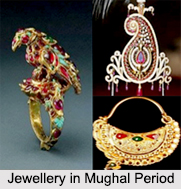
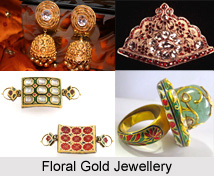
 Mughal Gemstones on Gold Floral Jewellery are among the most important of the jewellery produced during the Mughal period. The jewels of this group include a wide range of features which closely parallel those of other types of pieces, helping to place the latter as well as to throw more light on the former.
The single most important feature common to the Mughal Gemstones on Gold Floral Jewellery is the relatively extensive gold ground, which is typically engraved and chiselled, the decoration often consisting of quite elaborate floral and foliate motifs, but sometimes also featuring animals and birds in the same style.
An instance of one of the most outstanding pieces of such jewellery of Mughal Gemstones on Gold Floral Jewellery designing in the Mughal period is a dagger and scabbard. It is consistently paralleled by representations in miniature paintings as to leave little doubt that it should be dated to the period around 1610 to 1620, during the reign of the Mughal emperor Jahangir (1605-27).
The dagger is the most elaborate production of this school which is known to have survived. It originally included, among other features, more than 2,400 separately cut and set `stones`, of which 2,393 remain, most being rubies, diamonds and emeralds, but also including banded agate, ivory and glass where appropriate. It is extensively engraved, and has a `repousse-worked` scabbard back. And yet with all these elements, all this razzle-dazzle, and all the subtle intricacies of design and execution, it is a fully integrated and unified work of art.
Another breathtaking piece is an archery ring, now housed in the State Hermitage Museum in St Petersburg. Mughal Gemstones on Gold Floral Jewellery provides all-important, incontrovertible evidence of origin, since its interior decoration features on a field of engraved gold that is closely similar to that of the dagger, the title typically used to inscribe objects in the name of Shah Jahan (reigned 1628-58). This beautiful calligraphy is executed in the same kind of sunken, flat, channel-set ruby work as is seen on the above-mentioned dagger.
These mentioned are just some of the many works of gemstones on gold floral background which were so popular during the era of the Mughal rule in India.