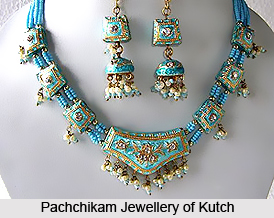
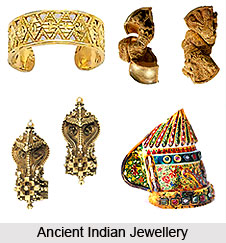
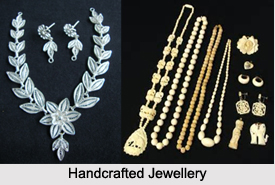
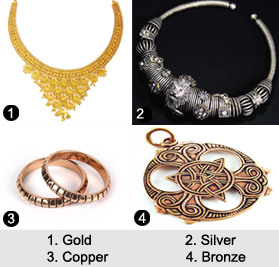
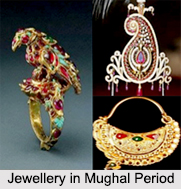
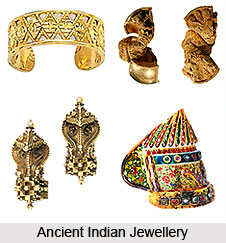
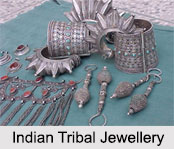
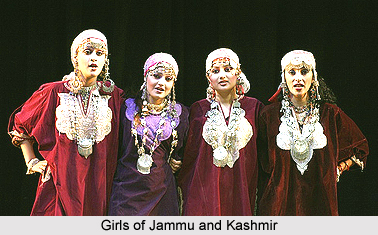
 Tribal jewellery of Jammu and Kashmir is prevalent in the state and is mainly made out of gold, silver and stones. Over the years they have excelled themselves to do something new and thus made their journey so exclusive and unique. Their works are very genuine in style. They offer a lot of variety as well as latest trend in their work, which is accepted by all.
The tribal men and women of Jammu and Kashmir usually wear a special circular type of earring, which they call `kundalas`. The womenfolk also love to wear "Nupura", which is actually a type of large anklets.
The women of Rajouri district usually wear a silver cap or crown on the head under the veil and they call it as `chaunk phool`. On forehead they usually wear `tika`, they also wear nose ring, which they call balu. There is a number of bridal jewellery that are mainly seen in this area and these can be mentioned as fine gold filigree wrist ornament and also other fine specimens. This wrist ornament is known as band or `kada`. Another important jewellery is `Halqaband`.
 This is mainly a traditional choker, studded with different stones such as ruby, emeralds, some semi-precious stones and even mirrors. This is made of silver, gold and brass, which has interlocking system, joined together with thread. Every Pandit women wear `dejihor` on their ear. This ornament hangs from the upper portion of the ear. This is usually symbol of marriage. `Gunus` is also popular even in today`s time. This thick bangle is made of solid gold and silver with a snake or lion head at either end. This is one of the popular and the most widely worn tribal jewellery of Jammu and Kashmir.
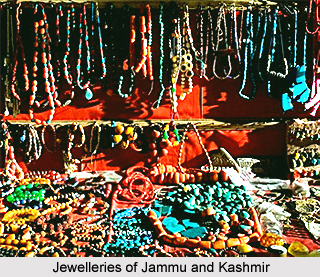
The various districts of this state mainly Srinagar, the capital City of Jammu and Kashmir is a center for precious and semi-precious stones. And these are properly used in making traditional as well as trendy jewellery. These are famous countrywide. Jhumkas and naths are very famous as they are commonly used by the localites. The jewellery of Ladakh Himalaya region is also very unique and distinctive in nature.
The women of this region wear an ornament called `sondus` or `branshil`. This is a marriage symbol usually fixed on the left shoulder. It has a few gold or silver discs connected by a number of long silver strands. This is basically inherited from the mother to the daughter at the time of marriage. Another extra-ordinary jewellery is known as `perak`. Mainly women of Ladakh wear this jewellery. This is really precious and contains 20 to 200 large turquoises and also other stones across a wide leather piece.
All these variety of ornaments really offer a vast option for the buyers and they always avail the opportunity in every possible way.