 The success of India in controlling the huge population and at the same time emerging as a powerful nation in the whole world is largely due to India`s foreign relations. India has a long record of allying with numerous countries and thus regarded as a champion among the other countries of the developing world. India was one of the pioneering members of the United Nations and the Non-Aligned Movement. India`s foreign relations also enhanced due to its membership with the eminent organizations of the world, namely, the WTO, ADB, SAARC, G8+5, East Asia Summit and G20.
Relation with Russia forms a significant step as far as the history of India`s foreign relations are concerned. Although at the time of the Cold War, India decided not to align with Russia or any other any main power blocs, India`s foreign relations underwent change afterwards. India developed close relations with the Soviet Union and received extensive military support from the U.S.S.R. India continues to have a strong military relationship with Russia.
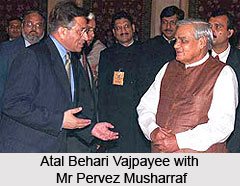
Among India`s foreign relations, relation with Pakistan is most significant, centering on Kashmir. The Hindu Maharaja of Kashmir, Hari Singh of Dogra, and its Muslim Prime Minister, Sheikh Abdullah, chose in 1947 to join India `provisionally` and temporarily. A `Standstill Agreement` with Pakistan was still prevalent making the matter of dispute. India sticks to the decision that subsequent elections in Kashmir for more than forty years have made it a fundamental part of India. Pakistan affirms the rights of the Kashmiri people to follow `self-determination` through a plebiscite and that too in accordance with the previous statement of Indian and also the UN decree. This dispute sparked off wars between the two countries in 1947 and 1965. There was a partial conflict in the year 1999. The state remains separated between the two countries by the Line of Control (LOC), which delimits the ceasefire line agreed upon in the 1947 conflict. Pakistan calls it a part of the state as Azad Kashmir. India terms it Pakistan Occupied Kashmir (POK). In 1997, Indo-Pakistan talks began after a halt of three years. The Prime Ministers of India and Pakistan met twice and the foreign secretaries conducted three rounds of talks. The year 2001 was a landmark in the history of India`s foreign relations. A summit was held in Agra, where the president of Pakistan, Mr Pervez Musharraf came to meet Indian Prime Minister Atal Behari Vajpayee. On June 20, 2004, both the nations decided to extend a nuclear testing ban and to set up a hotline between their foreign secretaries so as to prevent misunderstanding that otherwise would direct to a atomic war.
India has granted Pakistan unilateral "most favoured nation" trade status under WTO guidelines. However Pakistan is yet to respond. In the beginning of 2007, both countries showed interest to conduct dialogue for solving all stupendous issues.
India shares a relation with china and is also an important one among India`s foreign relations. Since 1988, initiatives had been taken to improve Sino-Indian relations thereby reducing tensions along the frontier and also by expanding trade and cultural links. A series of high level visits between the two countries have aided to progress relations. In December 1996, PRC President Jiang Zemin came to India while touring to South Asia. During his stay in New Delhi, the capital city of India, he signed, with the Indian Prime Minister, a series of `confidence-building` dealings for the dubious borders. This included troop reductions and weapons limitations etc.
Sino-Indian relations received a setback in May 1998 when the Indian Defence minister warranted the nuclear testing of the country. However, in June 1999, during the Kargil crisis, External Affairs Minister Jaswant Singh went to Beijing and stated that India did not consider China a threat. In 2003, India formally recognized Tibet as a part of China, and China recognized Sikkim as a formal part of India in 2004.Both India and China are members of the East Asia Summit.
The country now looks for opportunities to fortify its political and financial links with the United States, European Union, Japan, Israel, Latin America, and the Association of Southeast Asian Nations. India`s foreign relations also incorporate countries of African Union, the Commonwealth states and the Arabian states. The recent Necluer agreement 123 with USA is a major step in this direction.
The recent landmark of India`s foreign relations is very significant. India has enthusiastically took part in various UN peacekeeping operations, Also India is sending troops in huge numbers to the UN and also asking for a permanent seat in the UN India`s foreign relations enabled the nation to strengthen its foothold in the arena of world politics.