 Features of Assamese Vaishnava Drama reveal the uniqueness as well as some of the similarities with the Sanskrit Dramas. Vaishnava dramas are devoid of acts and scenes and flows in a continuous stream. This drama had a spiritualized myth poetic atmosphere. The initial inspiration of the Assamese ankiya nata is the anka type of Sanskrit drama. This drama delineates themes of Puranic origin. Heroism, love and other associations of a romantic nature are woven into the story in order to enhance its impact.
Sankardeva had made ankiya nata comprehensive with the initial difference that it consisted of only one act. Assamese Vaishnava drama made minor deviations. Deviation was made in order to offer entertainment to the people thereby stimulating education on the Lord Vishnu cult. On the stage battle is not depicted in Sanskrit drama. Sankardeva did the contrary in his dramas like Rama vijaya, Parijata harana, Rukmini harana. Amorous flirting was a taboo in Sanskrit drama; it is represented with pleasure in some of the dramas of Sankaradeva.
In Assamese Vaishnava drama, the nandi recitation constitutes the real prologue of the drama. It was addressed to Lord Vishnu. Amukha and prastavana are the two integral parts of the Assamese theatre. The language used in Vaishnava drama is Brajabuli. The language of Brajabuli was the recognised vehicle of the Lord Krishna cult in Assamese literature. Brajabuli was a literary language to which regional linguistic traditions imparted their characteristic verve and beauty.
Vaishnava dramas are prominent for their lyricism. The dramas open with slokas which are an indication and the lyrics that follow are an expansion of this thematic ideal. These songs are bhatimas, emotive lyrics or u and Payaras or hi. These songs are musical and devotional and aesthetically dignified and inspiring. The dramas helped in the emergence of a cultural legacy, song and dance, dramatic technique and stage-craft, prose and verse. Songs were employed to elaborate principal characters.
Religious absorption and spiritual rise was highly emphasized. In a drama when the emphasis is shifted then there is little scope for characterisation. The characters never suffered despite the limited canvas of the Vaishnava drama.
Assamese Vaishnava drama depicted abstract as well as concretized them through the medium of different sentiments like heroism and noble deeds, remorse and pity, battle and victory. The purpose of Vaishnava dramas was to make a religious impact. However dramatic effect existed in the conflict of interest and emotions. This is evident from Sankardeva`s plays like Rukmini harana, Parijata harana, Rama vijaya and so on.
Elevation of the mind to a spiritualized level was one of the main aims of Assamese Vaishnava school of Drama. The characters had to conform to mythological concepts. They had no independent existence and the description of character was limited. Assamese Vaishnava drama was bounded by the propaganda motif. Dramas like Rama vijaya, Rukmini harana, Parijata harana by Sankardeva and Arjuna bhanjana and Bhojan vihara by Madhavdeva are artistically and technically attractions. Tragedy was outside the acquaintance of Assamese Vaishnava drama. However some aspects of tragedy are to found in a few Vaishnava dramas like Kamsa vadha and Ravana vadha.
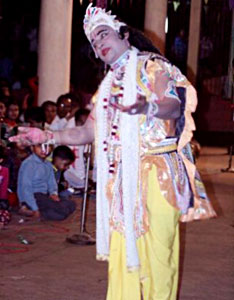
Vaishnava drama was performed either in the precincts of namghars. It was customary to set up pandals called rabhaghars when dramas were performed in religious institutions. The Krishna cult constituted these dramas. A place was set apart for the orchestra. The stage did not have any painted scenes.