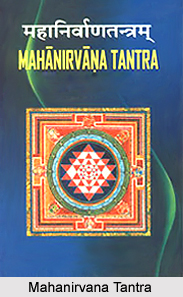
 Ethics in Mahanirvana Tantra are reminiscent of the moral values inculcated by the Bhagavad Gita, the Buddhist Sermons and Manu`s law book. These ethics of the Mahanirvana Tantra are mostly found contained in Chapter VIII of the work. Though there are no caste distinctions in the actual Sakta ritual, all castes and sexes being accounted equal, the castes are nevertheless recognised in agreement with Brahmanism. The only exception here is that in addition to the usual four castes a fifth one is added, namely that of the Samanyas. This caste is said to have arise out of the intermingling of the four older castes. Whereas the law book of Manu speaks of four Asramas or stages of life, the Mahanirvana Tantra teaches that in the Kali epoch there are only two Asramas, the state of the householder and that of the ascetic. For the rest, all which is taught here about duties to one`s parents, to wife and child, to relatives and to one`s fellow men in general, might be found exactly the same in any other religious book or even in a secular manual of morality.
As regards the duties of the householder, he should be devoted to the contemplation of Brahman and possess knowledge of the Brahman, and should deliver whatever he does to Brahman. He should not tell an untruth, or practise deceit, and should always be engaged in the worship of the Devatas and guests. Regarding his father and mother as two visible incarnate deities, he should ever and by every means in his power serve them. Even if he is starving to death, the householder should not eat without first feeding his mother, father, son, wife, guest and brother. The householder should never punish his wife, but should cherish her like a mother. If she is virtuous and devoted to her husband, he should never forsake her even in times of greatest misfortune.
A father should fondle and nurture his sons until their fourth year, and then until their sixteenth they should be taught learning and their duties. Up to their twentieth year they should be kept engaged in household duties, and thenceforward, considering them as equals, he should ever show affection towards them. In the same manner a daughter should be cherished and educated with great care, and then given away with money and jewels to a wise husband. The man who has dedicated tanks, planted trees, built rest-houses on the roadside, or bridges, has conquered the three worlds. The man who is the happiness of his mother and father, to whom his friends are devoted, and whose fame is sung by men, he is the conqueror of the three worlds. He whose aim is truth, whose charity is ever for the poor, who has mastered lust and anger, by him the three worlds are conquered.
The duties of the separate castes as well as the duties of the king, do not greatly differ from those laid down by Manu. The value of family life is put very high. Thus there is a strict injunction that no man who has children, wives or other near relatives to support, shall devote himself to the ascetic life. In complete agreement with the regulations in the Brahmanical texts, Chapter IX describes the `sacraments` (Samskaras) from conception till marriage, and Chapter X similarly gives instructions for the burial of the dead and the cult of the departed (Sraddhas).
A certain strange feature of the Saktas as regards marriage is that, in addition to the Brahma marriage, for which the Brahmanical rules provide, there is also a Shaiva marriage, i.e., a kind of marriage for a certain time, which is only permitted to members of the circle of the initiated. However, the children of such marriages are not legitimate and cannot inherit. This shows to how great an extent Brahmanical law is valid for the Saktas too. Thus also the section on civil and criminal law in Chapters XI and XII agrees in essentials with Manu.
Thus it can be seen from the foregoing discussion that ethics in the Mahanirvana Tantra are more or less in keeping with the general rules of morality prescribed by the various religious texts.