 Epic Society in India has been named so because some of the greatest epics originated at the time. It is believed that the greatest epics of the country, Ramayana and Mahabharata had actually originated much earlier. The epics, Ramayana and Mahabharata, had not always been in their present forms. Possibly several centuries elapsed between their origin and their later compilation. The epic society in India is portrayed in a very vibrant manner. The epic stories used to be sung by bards in royal courts or by travelling singers. Even after the epic stories were written there were additions, alterations and interpolations. Each of the epics exists in different recensions.
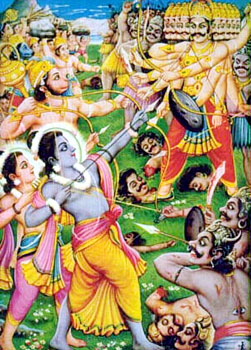
Scholars like Winternitz believe that the Mahabharata took the present shape around 4th century A.D. and that the Ramayana assumed the final form a century or two earlier. Ramayana mentions two cultures besides the Aryan. Of these, one was that of the monkeys (Vanara), friendly towards the Aryans and the other that of the demons (Raksasa), hostile to them. Both of them belonged to South India. Some think that the so-called Vanaras were not actually monkeys, but human beings with the monkey as their totem. Their peculiar appearance and grotesque gestures and postures were perhaps responsible for their designation as `Vanara`. The dark-skinned, fierce-looking and ferocious Raksasas did not owe loyalty to the Aryans; rather they tried to cause harm to them. The Raksasas had plentiful material prosperity and considerable martial skill.
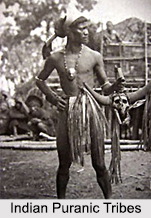
Epic society in India had various social classes and strata. Like for instance, Ramayana mentions low-class people and tribes like Nisadas, Sabaras, etc. A tribe was called Grahra. They either used the vulture as their symbol or used to move from one place to another like birds. This epic also mentions Yaksas and Nagas. The Yaksas were very powerful and originally they were possibly closely associated with the Raksasas, and later driven away to the northern region. The Nagas used snakes as their symbols. It also appeared that they established a kingdom including Ceylon and Malabar. The Naga women were renowned for their beauty. Ravana is said to have abducted many such women. This epic also has mentions of Asuras, who were stated to have indulged in various sinful acts. A class of women, called Apsaras (nymph) is met with in the Ramayana. Due to their exquisite beauty, they were regarded as semi-divine. They are said to have disturbed the penance of sages. Though generally conforming to the orthodox Brahmanical religion, the epic contains atheistic ideas.
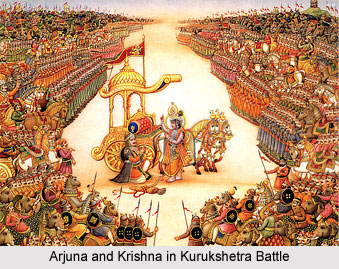
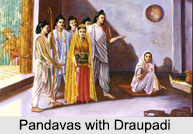
The main characteristics of the Mahabharata society were really diverse. Though the traditional Varnasrama dharma appears to have been generally followed in the epic, yet it testifies to the popularity of Vaishnavism and Shaktism. None of these two faiths shows conformist adherence to the Vedas. The Pancharatra sect of the Vaishnavas and the Pasupatas among the Shaivas claimed a large number of adherents. The Buddhists and the Carvakas used to propagate anti-Vedic doctrines openly. Further, this epic betrays a number of departures from the conventional Brahmanical belief. The ideal of one husband of a woman has been violated in Draupadi`s having five husbands. There are instances of people of a lower class attaining a high position like Brahmins by impression of merit. Thus, through this epic it appeared that the low-born person was not necessarily debarred from responsible work and was not deprived of respect in the epic society.