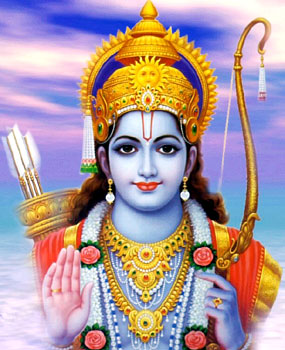
 Early days of Rama is well-described in the Bala Kanda alongwith his other three brothers. The four sons of the king of Ayodhya grew up to early manhood, excelling all in bravery and virtue. Rama especially became the idol of the people and the favourite of his father. Learned in the Vedas, he was no less an expert in the science of elephants and horses and in riding cars, and a very mirror of courtesy. Lakshmana devoted himself to the services of his elder brother Rama, so that the two were always together. Like a faithful shadow Lakshman followed Rama, sharing with him everything that was his own, and guarding him when he went abroad to exercise or hunt. In the same way Satrughna attached himself to Bharata. So it was till Rama reached the age of sixteen.
There was a great Rishi by the name of Vishwamitra, originally a Kshatriya, who by the practice of unheard-of austerities had won from the gods the status of Brahmarishi. He dwelt in the Shaiva hermitage called Siddhashrama, and visited Ayodhya to ask a boon from the noble king Dasharatha. There were two rakshasas, Suvahu and Maricha, who were supported by the wicked demon king Ravana, continually disturbed the sacrifices of the sage and polluted his sacred fire; none but Rama could overcome these devils. Dasharatha gave a grand welcome to the revered sage Vishwamitra, and promised him any gift that he wanted; but when he came to know that his dear son Rama was needed for so terrible and dangerous a service, he was scared, and it seemed as though the light of his life went out. However, he could not break his word, and it came to pass that Rama and Lakshman went away with Vishwamitra for the ten days of his sacrificial rites. But though it was for so short a time, this was the beginning of their manhood and of love and strife.
Vashishtha cheered Dasharatha, assuring him of certain victory for Rama. So, with the blessings of his father, Rama set out with Vishwamitra and his brother Lakshman. A cool breeze, delighted at the sight of Rama, fanned their faces, and flowers rained down upon them from the sky. Vishwamitra led the way; the two brothers, carrying their bows and swords, wearing splendid jewels and gloves of lizard-skin upon their fingers, followed Vishwamitra like glorious flames, making him bright with the reflection of their own radiance.
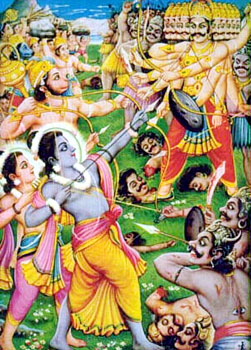
Arrived at the hermitage, Vishwamitra and the other priests began their sacrifice; and when the rakshasas, like rain-clouds obscuring the sky, rushed forward in horrid shapes, Rama wounded and put to flight Maricha and Suvahu, and slew the others of those evil night-rangers. Thus, the sacrificial rituals were peacefully completed by the great same Vishwamitra along with others and thus and after this Rama, along with Lakshmana marched towards Mithila with sage Vishwamitra where the King Janaka organized a swayamvara for his daughter Sita.