 The ancients mined mostly Sedimentary Rocks i.e., the river gravels and conglomerates, a few Igneous Rocks i.e., Kimberlites and Lamproites and surface soils distributed mainly in the districts of Krishna, Guntur, Mahbubnagar, Kurnool, Prakasam, Cuddapah and Anantapur districts. Diamonds are found in a variety of rock types including meteorites. The Kimberlites and the Lamproites, considered as primary source rocks for diamond, are magnesium, potassium and titanium rich ultra basic rocks.
Diamonds of India
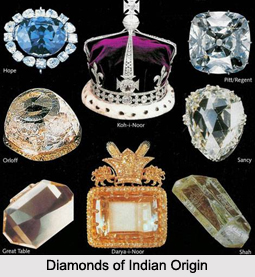
Along the banks of the Krishna River, aptly termed as "Diamond River", for a length of about 300 km between Sangam, the confluence of the Krishna and Tungabhadra River, and Vijayawada in Andhra Pradesh, particularly Kolluru-Paritala belt, was the scene of intense mining activity producing a galaxy of historically world famous diamonds, such as:
•The Koh-i-Noor (186 ct),
•The Great Mogul (787 ct),
•The Pitt or Regent (410 ct),
•The Orloff (300 ct),
•The Nizam (440 ct)
•The Hope (67 ct)
Of all the diamonds, the Koh-i-Noor is more famous and perhaps it is the only diamond, which fell into many hands and crossed borders of several countries without being sold and ruled the destinies of many kingdoms.
Historical accounts though differ on the authenticity of the period of their recovery, and their weights, all point to the Krishna Valley as the source for these celebrated diamonds. From ancient times until the 18th century, all the world"s diamonds came from India.
Mines in India
Famous conglomerate mines were at Ramallakota, Banganapalle, Vajragiri and Munimadugu in Kurnool district and Kolluru in Guntur district. The surface soils of the Wajrakarur and Jonnagiri areas in Anantapur and Kurnool districts and a few of the Wajrakarur Kimberlite pipes in Anantapur district and the Chelima Lamproite dykes in Kurnool district were also mined for diamonds. Large size diamonds were not only recovered from the Krishna gravels but also from the mines of Wajrakarur area known for many Kimberlites bodies, under the Vijayanagar Kingdom.
Many, in the earlier times, mentioned about the occurrence of diamonds in Raichur area of Karnataka during Vijayanagar Empire (1420-21). The central-eastern part of India had also witnessed ancient diamond mining activity centered on Wairagarh. They are located about 125 km northeast of Chandrapur in Maharashtra and at the confluence of Satti Nadi and Kobragarhi, tributaries of the Wainganga River. The Mahanadi River gravels in Sambalpur-Hirakud area in eastern India also witnessed diamond mining in the medieval period.