
It has been incorporated in the Jain Philosophy that there are five conditions of the souls. All the five conditions of the soul have been well-classified by the Jain Philosophers. The five conditions of the soul are as follows:
1. Parinamika Bhava, the condition in natural disposition. This includes the qualities of the soul in which nothing is changed by Karma, i.e. the Spiritual nature, capacity for salvation non-salvation, etc.
2. Audayika Bhava, the condition based upon the unhindered production of Karma. It includes all the accidental attributes of the soul which appear in it by the production of Karmas, like ignorance, heterodoxy, emotions, colours of the soul, affiliation to one of the stages existence, etc.
3. Aupasamika Bhava, the condition based upon the suppression of Karma. By this one can understand the faith and the conduct of life seen in the soul when Mohaniya Karmas appear, i.e. particularly when the emotions have been suppressed to the extent that they do not appear, although they exist.
Ksayika Bhava, the condition based upon the annihilation of Karma. It comprises the true faith, perfect conduct, and capacity to know and to see everything, as also the complete energy, in short, everything, that is developed in the soul when the Karma has disappeared without any trace.
Ksayopasamika or Misra Bhava is the condition of the soul in which the Karma has partially disappeared and is partially suppressed. This condition, however, is not, as one would like to suppose from the name, a combination of 3 and 4, but indicates a deeper stage than these two, insofar as there is only a lower degree of faith and the perfect conduct here and the karmas which restrict the knowledge, seeing and energy are only partially ineffective.
The five conditions which can be schematically and somewhat arbitrarily divided into 53 sub-types can be developed in the soul simultaneously in smaller or greater number. The proposition of the doctrine of five divisions which conditions aims at giving a principle of division which enables one to determine exactly which conditions of a soul follow from its nature, which are added by the production of Karma and which can arise by making it ineffective.
Conditions of Soul
Conditions of soul within the individual differs according to the state of Karma. Condition of the soul also determines the nature of the individual.
Recently updated articles in Indian Philosophy
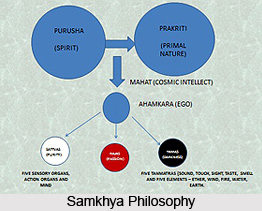
Samkhya Philosophy
Samkhya philosophy is one of India’s oldest intellectual traditions, explaining reality through the interplay of Puruṣha (pure consciousness) and Prak...
Maya, Prakriti in Hinduism
Maya or illusion is a very potent instrument of the Divine Prakriti, the Primal nature. In Hinduism one must be able to come out of Maya in order to a...

Samadhi in Hinduism
Samadhi is the result of meditation or that state of mind when there is an absence of all idea of individuality.

Samadhi in Buddhism
According to Buddhism, oen can only achieve samadhi through strict meditation and right concentration.

Abdul Rehman Jilani Dehlvi
Syed Abdul Rehman Jilani Dehlvi was a renowned Sufi saint of the Qadri Order in India.
Related articles in Indian Philosophy

Ajivika Philosophy
Ajivika philosophy is different from the mainstream religion

Indian Philosophy In The Vedic Period
Indian Philosophy in the Vedic Period was primarily based on the concepts of nature worship.
Achintya Bheda Abheda Philosophy
Achintya-Bheda-Abheda is a School of Vedanta that represents the philosophy of unimaginable one-ness and difference in relation to the power creation...
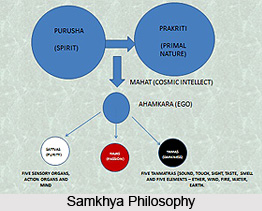
Samkhya Philosophy
Samkhya philosophy is one of India’s oldest intellectual traditions, explaining reality through the interplay of Puruṣha (pure consciousness) and Prak...

Charvaka Philosophy
The Charvaka Philosophy believes that only those things that can be perceived is the ultimate reality.