
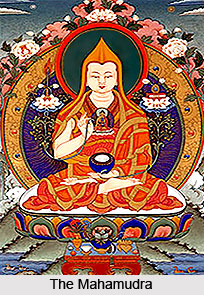
 Mahamudra in Vajrayana is a body of teachings that represents the culmination of all the practices of the new translation schools of Tibetan Buddhism, who believe it to be the quintessential message of all of their sacred texts. Mahamudra also refers to the sophisticated Buddhist systems of meditation and practice that helps in the realisation of this great sealing nature. The distinguishing characteristic of these methods are to discover the relationship between mind and reality. When the mind gets perplexed with the reality and fantasy, one tends to create problems for himself.
Mahamudra in Vajrayana
Mahamudra in Vajrayana literally means ‘great seal’ which refers to the sophisticated Buddhist systems of meditation and practice that helps in the realisation of this great sealing nature.
Introduction
Mahamudra in Vajrayana is a body of teachings that represents the culmination of all the practices of the new translation schools of Tibetan Buddhism, who believe it to be the quintessential message of all of their sacred texts. Mahamudra also refers to the sophisticated Buddhist systems of meditation and practice that helps in the realisation of this great sealing nature. The distinguishing characteristic of these methods are to discover the relationship between mind and reality. When the mind gets perplexed with the reality and fantasy, one tends to create problems for himself.Etymology of Mahamudra
Mahamudra in Vajrayana literally means "great seal" or "great symbol". Mahamudra is a Sanskrit word that refers to the nature of all phenomena. Mudra refers to the fact that each phenomenon appears vividly, and "Maha" refers to the fact that it is beyond concept and imagination. The fact that everything is devoid of existing in any impossible manner thus validates that things actually exist.
History of Mahamudra
The word Mahamudra has been used over the course of hundreds of years in both the Indian and Tibetan history. This term have been adapted variously like "a ritual hand gesture" or "one of a sequence of "seals" in Tantric practice" or "the nature of reality as emptiness". It can also mean to be the supreme attainment of Buddhahood at the culmination of the Tantric path.
The word "Mahamudra" has been used during the 7th century. Later it was largely associated with the Buddhist tantra. Here, it also denotes a hand gesture, now linked to three other hand mudras - the action (karma), pledge (samaya) and dharma mudras. It also involves chanting of mantras that symbolize and help to achieve one"s awakening mind.
The word "Mahamudra" has been used during the 7th century. Later it was largely associated with the Buddhist tantra. Here, it also denotes a hand gesture, now linked to three other hand mudras - the action (karma), pledge (samaya) and dharma mudras. It also involves chanting of mantras that symbolize and help to achieve one"s awakening mind.
Classifications of Mahamudra
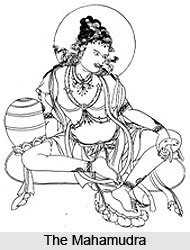 The classifications of Mahamudra have been done according to the teachings of Lord Gampopa`s lineage. The three classifications of Mahamudra are Sutra Mahamudra, Mantra Mahamudra and Essence Mahamudra. Sutra Mahamudra is associated with the sutra teachings while Mantra Mahamudra is related to the mantra teachings.
Sutra Mahamudra : The teachings of Mahamudra were derived by Lord Buddha and his followers. These were based in the Prajnaparamita Sutras. These sutras preach about `the great emptiness.` The shortest of the Prajnaparamita sutras is the Heart Sutra. These educate about the unity of form and emptiness.
The teachings on buddha nature are the other basis for Sutra Mahamudra. The Buddha nature teachings point out that the nature of our mind, emotions and thoughts is complete wakefulness. That wakefulness is what we call buddhahood or enlightenment. Furthermore, that enlightenment is the nature of all sentient beings. This essence of enlightenment is what we call `buddha nature` or tathagatagarbha.
These two streams of teachings form the basis for the sutra aspect of Mahamudra. The practice of Sutra Mahamudra involves the study of different sutras which also involves meditation. This process helps one to discover the heart of enlightenment.
The meditation of Sutra Mahamudra essentially consists of resting one`s mind, free of mental activity, in the state of nonconceptual wisdom. The Sutra Mahamudra relates to the mind resting in the state in which it experiences the dharmadhatu, which is the expanse or nature of all things. This resting is essentially "a nonconceptual wisdom beyond all elaboration" or "the unity of clarity and emptiness."
The object of one`s meditation is luminosity free of any projections; the perceiving subject is the lack of mental engagement; and one meditates without mental engagement. There are many extensive explanations on meditating without mental engagement, found primarily in the teachings of Maitripa and Sahajavajra. The Sutrayana approach to Mahamudra is seen as a very profound method because it does not require any of the sophisticated and complex tantric rituals, deity yoga practices, or samayas. This particular approach is also known as "a secret passage." The direct and profound methods of Sutrayana Mahamudra are found right within the sutra approach, right within the ordinary and simple path of spiritual practice.
Mantra Mahamudra : Mantra Mahamudra is the second aspect of the Mahamudra tradition. This section deals with philosophical approaches that include working with creation and completing the stage deity practices. It also includes detailed instructions on working with nadi, prana and bindu. The main presentation of Vajrayana Mahamudra is found in the anuttarayoga tantras.
The tantras are transmitted through the four principal abhishekas or empowerments. When Mahamudra is introduced as the naked, natural state through the use of Vajrayana methods, this is called Mantra Mahamudra. Vajrayana path has a variety of methods that helps in realizing the state of mind. Mantra Mahamudra comprises of various means of pointing out mind`s nature like the process of the four abhishekas.
When we go through the initiation process of an abhisheka, we are empowered to practice the mandala of a particular deity, which symbolizes the nature of mind. This is the traditional way of introducing us to the nature of mind. The images of the deities that we see represented in paintings and sculptures are actually reflections, mirror images, of the nature of our own minds.
Even the pure and impure aspects of mind are depicted in these symbolic images of a deity. Thus Vajrayana Mahamudra gets reflected through the deity yoga practice. The Vajrayana Mahamudra deity practice is very popular. One often misunderstands the images that they see and to misinterpret the deity as an entity external to ourselves. The source of understanding the Vajrayana path is the instructions of the lineage and the Vajrayana tantras. It is through this clear understanding that we are able to relate to Vajrayana deity practice.
Essence Mahamudra : Essence Mahamudra leads to the sudden realization of the true nature of mind, which is known as thamal gyi shepa or in other words ordinary mind. Essence Mahamudra is practiced when an extremely realized guru bestows his blessing also known as adhishthana to his devoted and competent student. This is known as the vajra wisdom`.
Essence Mahamudra empowerment is regarded as the descent of the actual realization of the root and lineage gurus upon a student. Through this descent of the blessings of this vajra wisdom, thamal gyi shepa suddenly awakens in that student`s heart and is fully recognized on the spot. As a result, the student experiences what is called "simultaneous realization and liberation."
The Essence Mahamudra path is completely formless. This path does not require practise of any elaborate methods of Mantra Mahamudra or the gradual training of Sutra Mahamudra. The transmission happens instantly. In the Essence Mahamudra tradition, all conceptual clinging, such as clinging to ideas of `sacred and profane` or `virtuous and non-virtuous,` is cut through and executed directly with the experience of mind and its nature.
Stages in Mahamudra
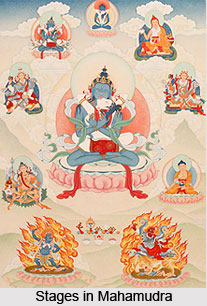 Mahamudra meditation which is a body of teachings can be explained according to the completion stage of Highest Yoga Tantra. According to Secret Mantra, Mahamudra is the union of spontaneous great bliss and emptiness. According to Secret Mantra, Mahamudra is divided into two stages: causal-time Mahamudra and resultant-time Mahamudra.
Causal-time is the time spent on the path leading to full enlightenment. It is for this reason that the causal-time Mahamudra is the Mahamudra practised before the attainment of Buddhahood. Resultant-time Mahamudra is the Union of No More Learning, which is the actual state of Buddhahood.
Causal-time Mahamudra is further divided into two successive stages: the Mahamudra that is the amalgamation of spontaneous great bliss and emptiness and the Mahamudra that is the union of the two truths. The first union takes place when the subjective mind of spontaneous great bliss recognizes emptiness as its object. This emptiness is regarded as same in both Sutra and Secret Mantra. The only thing that differs is the mind realizing this emptiness. It is the subjective mind of spontaneous great bliss that makes Secret Mantra meditation superior to Sutra meditation. For the attainment of complete enlightenment one needs to realize the emptiness with the mind.
The spontaneous great bliss can be experienced only when with the force of meditation one can cause the winds to enter and dissolve within the central channel. As a result of this action the white drop melts and flows through the central channel. This form of realising the emptiness through the spontaneous great bliss was essentially practised by the great Secret Mantra Masters of ancient India such as Saraha, Nagarjuna, Tilopa, Naropa, and Maitripa.
The second stage of causal-time Mahamudra is the Mahamudra that is the union of the two truths: the conventional and the ultimate. Here the pure illusory body is known as conventional truth. Combining these two truths within one person`s field is known as the Mahamudra. This Mahamudra is known as the the union of bliss and emptiness. Causal-time Mahamudra therefore contains both a cause and a result. Through the force of accomplishing this two-stage causal-time Mahamudra we will attain the resultant-time Mahamudra, or actual Buddhahood possessing the seven pre-eminent qualities of embrace. This concludes the explanation of the general paths of Secret Mantra.
Practice of Mahamudra
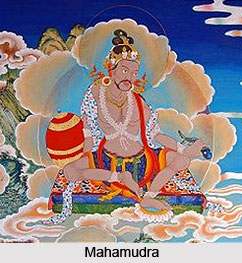 Mahamudra in Vajrayana is considered as the highest level of teaching within Tibetan Buddhism. It is the realization of the very nature of mind itself. There is not a single experience which is not included within the consciousness of Mahamudra. In learning the mahamudra meditation proper instruction and guidance of a qualified teacher is very essential. Mahamudra is frequently preceded by pointing-out instruction.
The practice of Mahamudra is done through transmission of few of the texts verbally and also through empowerments and `reading transmissions`. Before realising the formless practices a practitioner first needs to practise various Tantric practices. These meditative practices of Mahamudra are divided into two approaches that have been described below.
Mahamudra Samatha and Vipasyana : According to the Buddhist schools of meditation, the two meditative approaches of mahamudra have been divided into Samatha which means tranquillity and Vipasyana that means special insight.
Mahamudra Samatha : Mahamudra Samatha deals with instructions on different postures and breathing exercises for meditation. It also guides the practitioner with instructions on identifying our subtle mind. The Mahamudra Samatha also preaches about the teachings on how to control a mind that is overwhelmed with various obstacles and thoughts. There are usually two types of Mahamudra Samatha that are taught, samatha with support and samatha without support.
Mahamudra Samatha with support engages the utilisation of an item of attention to which the mediator continually returns his attention. One of the main techniques involved in Mahamudra samatha with support is mindfulness of breathing. It helps in calming the mind to prepare it for the stages that follow. For the Kagyupa, in the context of mahamudra, mindfulness of breathing is thought to be the ideal way for the meditator to transition into taking the mind itself as the object of meditation and generating vipasyana on that basis.
Mahamudra Samatha without support engages in objectless meditation. Here the practitioner rests the mind without the use of a specific focal point.
Mahamudra Vipasyana : For Mahamudra Vipasyana, Wangchuck Dorje had given ten separate contemplations that help to unveil the essential mind within; five practices of `looking at` and five of `pointing out` the nature of mind. They all presume some level of stillness cultivated by mahamudra shamatha. These elaborate directions for the insight practices make mahamudra exclusive in Tibetan Buddhism.
Recently updated articles in Religion in India
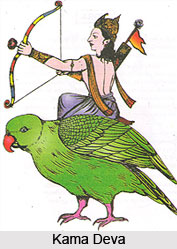
Kusumayudha
Kusumayudha is a name of Kamadeva, the Hindu God of Love. Depicted with a sugarcane bow and flower-tipped arrows, he represents attraction and longing...

Bhoyar Caste
Bhoyar Caste is largely found in the Central Provinces of the country. Traditional occupation of Bhoyars is agriculture. They are good cultivators and...
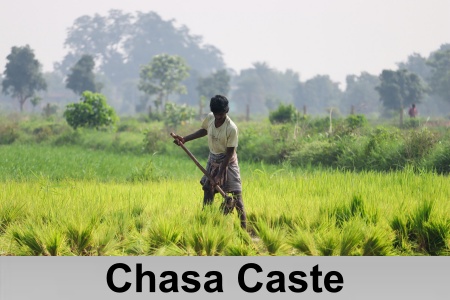
Chasa Caste
Chasa caste is a prominent agrarian community native to Odisha. Traditionally associated with cultivation and farming, Chasas have historically played...
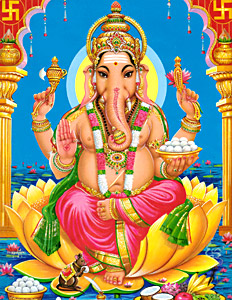
Vigneswara, A Form of Lord Ganesha
Lord Vigneswara is another form of Lord Ganesha or Vinayaka, prominently worshipped as the God of intelligence and good luck in the Indian subcontinen...
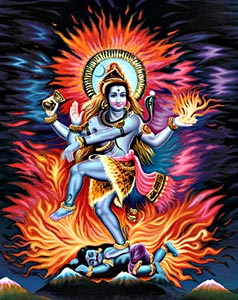
Maheswara
Maheswara, meaning “the Great Lord,” is a revered name of Lord Shiva in Hindu tradition. It represents Shiva’s supreme authority over creation, preser...
Related articles in Religion in India

Religion in Indus Valley Civilization
Religion in Indus Valley Civilisation included Hinduism, Buddhism and Jainism. Details about the religion in Indus Valley Civilization have been gathe...

Iyer Brahmin
Iyer Brahmins are originally from Tamil Nadu of South India. They are known for their adherence to Advaita philosophy and Smarta traditions. Tradition...

Kumbhakar / Kumhar Caste
Kumbhakar or Kumhar caste is a traditional artisan community in India known for pottery making. Derived from Sanskrit word Kumbhakar, meaning potter,...

Gujjars in Mughal Era
Gujjars in the Mughal era enjoyed great power. Further their power increased with the decline of Aurangzeb, Mughal emperor.

Gotra in Hinduism
In Hinduism, gotra refers to a lineage system tracing descent from ancient sages, primarily through the paternal line. Originating from Vedic traditio...