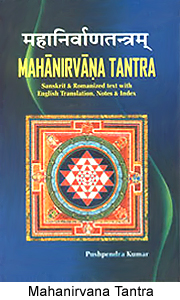
 Mahanirvana Tantra or the Tantra of Great Liberation in Sanskrit, is divided into several chapters, each dealing with various esoteric aspects of Tantra practice. It is framed as a dialogue between Lord Shiva and his consort, Parvati. A brief description of each chapter follows.
Chapter 1 of Mahanirvana Tantra
Chapter one is a prologue of sorts, with Parvati beginning with an apocalyptic vision of the Kali age, opining that men have fallen greatly from their noble ways and are beset by sin and wickedness. She asks Shiva how humanity may worship and be liberated in the Kali age
Chapter 2 of Mahanirvana Tantra
Chapter two is largely Shiva`s response to Parvathi`s question, and begins with the assertion that man`s steady degradation in the Kali Yuga has rendered Vedic ritual and practice ineffective in attaining moksha. He also asserts that Brahman is the supreme spirit and is the only path to salvation in the Kali age.
Chapter 3 of Mahanirvana Tantra
Chapter 3 again begins with Parvathi`s supplication, in this case, she asks Lord Shiva to explain to her the manner and means by which Brahman, the universal spirit may be worshipped in the Kali age. Shiva declares that Brahman is omnipresent, eternal and omniscient, and may be known by the wise by its internal nature, and for them he enjoins Samadhi-Yoga. For those who would know it by its external signs and who are more common, Shiva enjoins Sadhana, and proceeds to detail the same.
Chapter 4 of Mahanirvana Tantra
Chapter 4 begins with Parvathi`s request to clarify further Shiva`s assertion in chapter 3 that Brahman may be attained even by the worship of Parvathi, or Shakti. Shiva explains that she is the Para Prakriti (or supreme Nature) and from her has sprung all of existence, and she is its Mother. Shiva then insists that people of the Kali age can only attain Brahman by Kaulika worship, or that derived from knowledge of the Supreme Brahman.
Chapter 5 of Mahanirvana Tantra
In the 5th chapter, Shiva continues to expound on Shakti worship, and reveals an esoteric sadhana relating to it, involving the use of hitherto unknown mantras and rituals.
Chapter 6 of Mahanirvana Tantra
In chapter 6, Parvathi asks Shiva to tell her more about the Pancha Tattvas, (wine, meat, fish, parched grain and coition). He also delves into the Shri Patra, Homas in Tantra, the formation of Chakras and other rituals.
Chapter 7 of Mahanirvana Tantra
In chapter 7, Parvathi asks Shiva to tell more of the hymn of praise known as the Adya-Kali-Svarupa, and also of the protective mantra (Trailokya Vijaya) and Shiva recites the hymn and mantra, and explains their proper use.
Chapter 8 of Mahanirvana Tantra
In chapter 8, Parvathi asks about the castes and the stages of life as pertaining to the Kali yuga, which Shiva answers, adding a distinct fifth caste, Samanya (common), who are free to follow any occupation except those reserved for the Brahmanas, and details the customs and duties for each caste and life stage.
Chapter 9 of Mahanirvana Tantra
In Chapter 9, Shiva explains the duties of people in the Kali age further, expounding on the ten purificatory rites of conception, pregnancy, and birth of the child; the giving of its name, its first view of the sun, its first eating of rice, tonsure, investiture, and marriage, including the sacred thread ceremony (the last only for Brahmanas).
Chapter 10 of Mahanirvana Tantra
In chapter 10, in response to Parvathi question, Shiva details the ancestral rites (Vriddhi Shraddha), funeral rites, and the Purnabhisheka.
Chapter 11 of Mahanirvana Tantra
In chapter 11, Parvathi, noting again that the people of the Kali age are wicked and prone to sin, asks Shiva as to the expiatory rites that may be performed for liberation from sin. Drawing a distinction between sin that injures others (and punished by the King) and that which injures oneself, Shiva details the expiatory rites that may atone for misconduct with oneself.
Chapter 12 of Mahanirvana Tantra
Titled an account of the eternal and immutable Dharmma, the 12th chapter of the Mahanirvana Tantra is a monologue by Shiva on Dharma, or proper conduct. It is essentially an account of Dharma`s proper execution in all walks of life, including property, statecraft, ethics and good conduct.
Chapter 13 of Mahanirvana Tantra
In Chapter 13, Shiva answers Parvathi`s query on how the image of Mahakali must be imagined, and Shiva gives a comprehensive account of her form, adornments and mode of worship.
Chapter 14 of Mahanirvana Tantra
Parvathi then asks Shiva how the sacred immovable Shiva linga may be installed and worshipped. After answering the question, Shiva proceeds to describe the four Avadhutas, initiates of the highest Tantrik rituals and enlightened to the most esoteric Tantrik truths.
The Mahanirvana Tantra is an astonishingly detailed text that covers almost all walks of life and is a consistent and comprehensive moral, philosophical and ethical system. The chapters detailed here serve as a guide to its varied themes and observations.