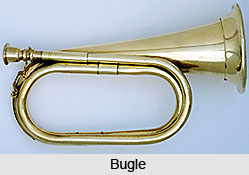
 The bugle is wind instrument of German origin. The bugle in its early form had valves and is believed to have been built ca. 1830 in Austria. They were brought to France ten years later. The bugle was modernized by Adolphe Sax and others to the form we know today. It is one of the simplest brass instruments. The earliest known bugles were shaped in a coil, mostly a double coil though a single or triple coil was also used. This was quite similar to the French horn and used to communicate during hunts and as announcing instruments for coaches. Instruments related to the bugle include the post horn, the Pless horn (sometimes called the "Prince Pless horn"), and the bugle horn.
The bugle has a cup mouthpiece and a wide bore. The tube is conical and has a relatively narrow bell. The bugle is less difficult to blow than the trumpet, trombone, or horn, but then again, this instrument does not sound as lively and radiant as the others. The bugle has a fierce timbre and is capable of extraordinarily rapid starts. It does not have any pitch control devices. All pitch control is done by varying the player`s embouchure, since the bugle has no other mechanism for controlling pitch. Consequently, the bugle is limited to notes within the harmonic series.
The bugle is used to this day in brass and marching bands, and is, of course, the instrument used for issuing such commands to the troops as reveille, mealtimes, and "taps", the last post. The first verifiable formal use of a brass horn as a military signal device was the Halbmondblaser - literally, "half moon blower" - used in Hanover in 1758. It was U-shaped (hence its name) and comfortably carried by a shoulder strap attached at the mouthpiece and bell. It first spread to England in 1764 where it was gradually accepted widely in foot regiments. Cavalry did not normally use a proper bugle, but rather an early trumpet that might be mistaken for a bugle today, as it lacked keys or valves, but had a more gradual taper and a smaller bell, producing a sound more easily audible at close range but with less carrying power over distance.