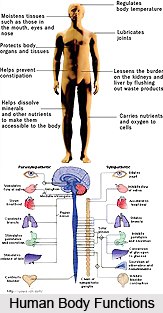
 Body functions are peculiar to the bodies of the Jivas which are in Samsara. They are called "prana" There are on the whole 10 different Pranas,`` They are:
1. Ayus "vitality".
2-4 the three Balas or powers of the body language, language and thought.
5. Ucchvasa-nihsvasa (Anapana), exhaling.
6-10. the functions of the organs of sense, (Indriya) of touch, taste, smell, seeing and hearing.
All the ten Pranas are present in the most highly developed beings; in the lower ones, only few of them but at least four (vitality, power of the body, breathing feeling).
The possession of more or less organs of sense acts as a principle for the division of the beings into different classes. One thus distinguishes the beings with 1, 2, 3, organs of sense and divides further those belonging to the class having 5 organs of senses into those who think and those who do not think.
Beings with one sense are those which have elements (earth, water, fire, wind) or plants as body. They are either "fine" (suksma), i.e. not perceivable all with the help of our senses, or crude (badara) and therefore visible.
Beings with 2 senses (touch and taste) are: worms, Shells, leeches, etc.; those with 3 senses (touch, taste, Smell): bugs, spider, etc.; those with 4 senses (touch, taste, smell, eyes) are bees, flies, etc.
Being with five senses is divided into two groups: those who are judicious and those who are not. The former have an inner sense (manas) and they judge action thinking while taking into consideration the condition of a thing in the present, past and future. Those who are not judicious act only from instinct. All the animals not born of a womb belong to these, the "Asamjnis" toads, fish, etc. Animals born of a womb, like goats, sheep, elephants, lions and tigers belong to the groups of Sairijnis. Human beings, gods and beings from the hell belong also to this group.
Beings of all these types can be present in the fully developed condition (paryapta) or in an undeveloped (aparyapta) one. Amongst the latter the organs of the body or capacities are not fully developed.