 History of Benares Gharana
Benares Gharana was developed by musician Ram Sahai more than 200 years ago. Sahai"s tryst with the tabla began at the age of five under the guidance of his father. At the age of nine, he moved to Lucknow to become the disciple of Modhu Khan of the Lucknow gharana. When he was seventeen, he got an opportunity to perform a recital for the new Nawab, Wazir Ali Khan. However, his Guru Modhu Khan agreed to let him play on one condition that he would not be interrupted until he finished playing. After this agreement, Ram Sahai played for seven consecutive nights without any interruption. Overwhelmed by his incredible performance, the community showered him with gifts.
After this, Ram Sahai returned to Benares and continued his performance there. However within few days, a time came when Ram Sahai felt the need to make a significant change in his tabla playing. With this aim, he withdrew into seclusion for six months and worked to develop what is now known as the Benares baj or style of tabla playing. He developed a new way of fingering the tabla strokes; composed numerous compositions within existing compositional forms and created new forms, such as uthan, Benarsi theka, and fard.
Features of Benares Gharana
The unique feature of Benares Gharana is that it is versatile enough to perform solo, and to accompany any form of music or dance. The gharana makes use of over twenty different compositional types, and has an enormously varied repertoire of each type. It is notable for its powerful sound.
Players of Benares Gharana
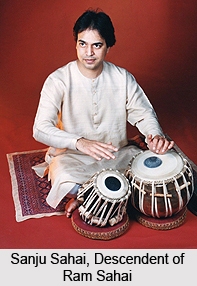
There are many artists known for playing Benares Gharana. Ram Sahai"s family members were heavily involved in this style of playing. The direct descendants making up the 6th generation of tabla players are Chandra Nath Shastri, Ramji Mishra, Mahapurush Misra, Ishwarlal Mishra, Chhotelal Misra, Radhakanta Nandi, Kashinath Mishra, Bityut Banerjee, Deepak Sahai, Sanju Sahai and Shiv Sahai.
The 7th generation consists of Kumar Bose, Aditya Sahai, Krishna Sahai and Shubham Sahai. Sanju Sahai, who represents the 6th generation, is one of the most sought after Tabla players of his generation. The other noteworthy artists of Benares Gharana include Kanthe Maharaj and his disciples: Badri Maharaj and Ashutosh Bhattacharya.