Tourism in Bawali deals with the Palace of Bawali, which is now converted into a heritage hotel in Budge Budge, some ancient Hindu temples of late medieval and colonial era, Garden of architectural excellence, Pujali, Budge Budge Ferry Ghar, Raypur and many others.
Bawali is a rural community settlement near the industrial town of Budge-Budge in
South 24 Parganas District of
West Bengal. Bawali, the semi urban town in Budge Budge came into existence during the rule of Mughal Emperor,
Akbar.
Palace of Bawali :
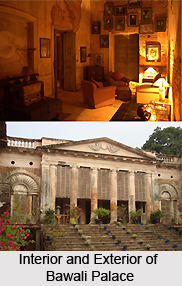
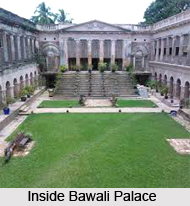
Palace of Bawali or Bawali Rajbari was erected in the later phase of medieval time that is during the rule of
Akbar, the Mughal Emperor. Bawali Rajbari is closely associated with the military life and personal life of Mondal royal family.
The history of Bawali Rajbari or Bawali Palace dates back with the Basudeb Ram who was an influential official of the Mughal Army probably that was the period of Emperor Akbar.
The son of Basudev Ram, Radheshyam took `Sannayas` leaving behind his only son Shobha Ram who was actually a resident of Basantpur - a village of Nadia District but as demanded by the profession he had to shift to village of Chandipur to oversee administrative job of a huge area centering around Budge Budge of
South 24 Parganas District on behalf of
British East India Company. Both the son of Sobha Ram, Meghnaad and Raja Ram were holding the high offices under the regency of British East India Company.
Once, Raja Ram had been able to put down insurgency of
Marathas at different parts of Bengal. He was successful in driving away the infamous
Marathas with sheer intelligence and valour and in appreciation he was rewarded with the `Royal Charter` empowering them to exercise full control over fifteen villages namely Bawali, Budge-Budge, Kalinagar, Saheban Bagicha and Chakmanik. They are referred as the title "Mondal".
Harananda Mondal, the grand son of Raja Ram fathered by Dasarath Rama was the most glorious successor who heightened the status of the royal family by acquiring great fortune by his business insight as well as efficient `Land Reforms` yielding good harvest as well as optimum revenue from the huge land holding comprising of Four Parganas like Balia, Magura, Muragacha etc. on which he expanded his feudal lordship about two hundred seventy five years ago during the transition period between the decline of Mughal Empire and advent of British Rule in India.
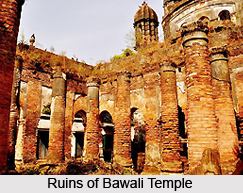
Harananda Mondal was very pious as well as religious mined person. He was also very compassionate with his tenants and sub-ordinates. He was the first person to develop Bawali as the temple town, with the architect Subal Chandra Mistry. In the following years an array of Vishnu Temples were built at different places by the descendants of Mondal Family. Some of the temples in Bawali are Radha Gopinath Jui Temple, Radhakanta Jui Temple, Rashmancha, Radhaballab Jui and Sridhar Jui`s Temple, Radhaballabh Jui Temple and Shyamsundar Temple, Gopalji Temple, Raj Rajeswar Temple, Chandimata Temple and Madan Mohanji Temple.
The huge opulent structure bearing beautiful art work with full marble flooring along with the Greco-Roman architecture carried the pomp and glory of this site.
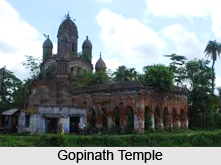
Navratna Gopinath Temple : Navratna Gopinath Temple was built during the same time, while the Bawali Rajbari was erected. It is believed that Rani Rashmoni built the famous
Dakshineshwar Temple, in the later phase of eighteenth century, inspired from the architecture of this temple in Bawali. A visit to the ruins of Navratna Gopinath Temple and its adjacent temples will be a nice experience for a weekend escaper.
 Ferry Ghat of Budge Budge :
 Ferry Ghat of Budge Budge has the modern historical significance. Ferry Ghat of Budge Budge greeted
Swami Vivekananda in 1897 when he returned from his Chicago visit. Till date, this event is celebrated by the people of Budge Budge on February 19 every year.
Raypur : Raypur is a census town under Budge Budge police station of Alipore subdivision in South 24 Parganas district in
West Bengal. A visit to Raypur riverside is breathtaking and the calm atmosphere is attracted by the nature lovers and the professional and amateur third eyes. Raypur is just 7 kms away from the Palace of Bawali.
Achipur : A trip to Achipur will be perfect weekend for a traveller, who finds the traditional Chinese dishes. One will find a Chinese Temple here still holding back its wood carvings and a grand entrance. Achipur was a Chinese settlement founded by the Chinese businessman, Tong Achi in the early phase of British Colonial era, who established a sugar mill here during the 1770 when
Warren Hastings was the Governor-General of Bengal. One can also see the cenotaph of Tong Achi, showing the grand architectural designs of Chinese traditions.
Boro Kachari Mandir : Boro Kachari Mandir is a famous temple in Bawali. It is around 6 kms. One will find the ruin of the ammunition depot of the British army, which is just located just beside the river, is worth a visit.

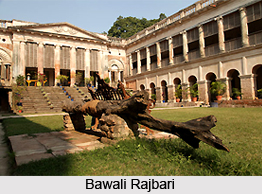 Bawali is a village town near the industrial town of Budge-Budge in South 24 Parganas District of West Bengal. Bawali, the semi urban town in Budge Budge came into existence during the rule of Mughal Emperor, Akbar.
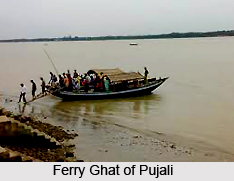 Bawali has witnessed many historical events like the crest and trough of dynastical rules from the medieval age to the time of Independence. The nearby ferry ghat of Budge Budge greeted