
"Then there was neither Aught nor Naught, no air nor sky beyond.
What covered all? What rested all? In watery gulf profound?
Nor death was then, nor deathlessness, nor change of night and day."-
Sanskrit Texts. Vol. V-
"Avyakta" as it has been named therefore stands for that what is indiscernible, invisible and imperceptible. In Indian philosophy and in the "Upanishad" the term Avyakta stands for describing the un manifested. It is just the opposite to "Vyakta" - the manifested or differentiated. In Hindu values Avyakta is applied to Vishnu and Shiva and in the Bhagavad Gita Avyakta is applied to Krishna.
The true aura of Avyakta can actually be felt in the Samkhya philosophy. The Samkhya is one of the six schools of classical Indian philosophy and is closely linked with Yoga. The essence of the un manifested that what defines Avyakta is therefore clear in the thirteenth chapter of the Samkhya philosophy where the distinction is made between the field of the material world and the knower of the field-- the soul. This is again somewhat equivalent to the "substratum of physical being" which is the very first entity that emerged from Brahman.
The field of the material world and the field of that unexpressed un manifested world in Samkhya philosophy is further clarified as consisting of five gross elements Earth, Air, Water, Fire and Akasa the ego (ahamkdra), consciousness (buddhi), and the unmanifest (avyakta)
Avyakta that still stands as the unmanifested, the invisible and the inexplicable is therefore the progenitor of "creation". Indian philosophy therefore clearly states that the "creation of every clear thing is from that unclear past".
Avyakta
It stands for invisible, imperceptible, a subtle spirit from which all phenomena of the material world of manifestation.
Recently updated articles in Indian Philosophy
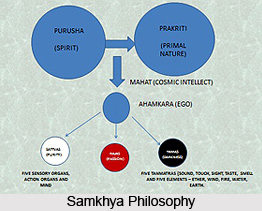
Samkhya Philosophy
Samkhya philosophy is one of India’s oldest intellectual traditions, explaining reality through the interplay of Puruṣha (pure consciousness) and Prak...
Maya, Prakriti in Hinduism
Maya or illusion is a very potent instrument of the Divine Prakriti, the Primal nature. In Hinduism one must be able to come out of Maya in order to a...

Samadhi in Hinduism
Samadhi is the result of meditation or that state of mind when there is an absence of all idea of individuality.
Samadhi in Buddhism
According to Buddhism, oen can only achieve samadhi through strict meditation and right concentration.

Abdul Rehman Jilani Dehlvi
Syed Abdul Rehman Jilani Dehlvi was a renowned Sufi saint of the Qadri Order in India.
Related articles in Indian Philosophy

Ajivika Philosophy
Ajivika philosophy is different from the mainstream religion
Indian Philosophy In The Vedic Period
Indian Philosophy in the Vedic Period was primarily based on the concepts of nature worship.
Achintya Bheda Abheda Philosophy
Achintya-Bheda-Abheda is a School of Vedanta that represents the philosophy of unimaginable one-ness and difference in relation to the power creation...
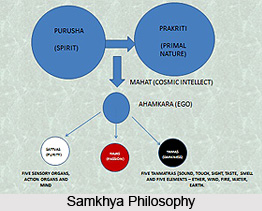
Samkhya Philosophy
Samkhya philosophy is one of India’s oldest intellectual traditions, explaining reality through the interplay of Puruṣha (pure consciousness) and Prak...
Charvaka Philosophy
The Charvaka Philosophy believes that only those things that can be perceived is the ultimate reality.