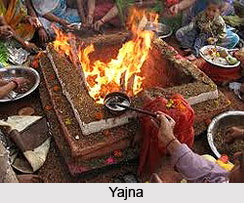
 Fire God in Agni Purana has discussed the ceremony, known as the Astra Yajna, should be performed in all rites undertaken for ensuring worldly success. The weapons, sacred to Lord Shiva, should be worshipped at the centre, while the weapons, such as the Vajra, etc.; should be worshipped in the different directions of the Mandala, commencing from the east. The five discuses, and the ten arms of the god, should be worshipped with a view to ensure success in battle. The planets should be worshipped in connection with the ceremony, whereby they would exert the same blissful influence, as they do when they are in the eleventh sign from that of one`s nativity.
In the course of discussing Astra Yajna, the fire God has also dealt with the rite of Astra Shanti, by which physical disturbances are quelled, epidemics are subsided, diseases, incidental to the malign influences of the baneful planets, are cured, and the enemies of the performer are annihilated. The Mantra, sacred to the Aghora manifestation of the god, and which is an infallible remedy for all diseases which owe their origin to the baneful influences of the Vinayakas, should be repeated, a hundred thousand times, in the beginning of the ceremony, whereby the evil influences of the planets would be removed. In cases of disturbances in Nature, libations, containing seeds of sesamum, and numbering a hundred thousand in all, should be poured in the fire, in succession, while phenomena portending evil, and restricting themselves to the sky, would vanish at the performance (of a Homa) consisting of libations, numbering half as much as in the preceding instance. Similarly, a hundred thousand libations of clarified cow-butter, poured on the fire, would quell all physical disturbances, which are peculiar to the earth.
It has been said in the Purana that a rite of Homa, performed with libations of scented gum resin soaked in clarified cow-butter, should be deemed as the pacifier of all disturbances, whether physical or political. A rite of Homa, performed with libations of clarified cow-butter, containing grains of sun-dried, rice and bunches of Durva grass, should be deemed as an infallible remedy for all sorts of bodily distempers. A thousand libations of clarified cow-butter would undoubtedly neutralise the ill effects of bad dreams, dreamt in the night. Likewise a ten thousand libations of clarified butter, containing the Java flowers, would propitiate the hostile planets and asterisms, whereas the same number of libations of clarified cow-butter, would cure all diseases that are incidental to the evil influences of the Vinayakas, and the malignant spirits. A Homa, performed with a ten thousand oblations of scented gum resin, would cleanse a spirit possessed by ghosts, and Vetalas, and a like ceremony should be gone through, on the occasion of a sudden falling off of a tree, of the class known as the Maha-Vrikshas, or of a perching down of a Vyala-Kanka on one`s house-top.
Similarly it has also been said that libations, consisting of clarified cow-butter, containing grains of sun-dried rice and bunches of Durva grass, should be poured on the sacrificial fire by a person, before entering a virgin forest. Libations, consisting of clarified cow-butter and the seeds of sesamum, remove all evils portended by earthquakes and meteor-falls. A ten thousand oblations of ; rented gum resin, would neutralise the ill effects of a tree, shedding blood, while a similar rite should be performed on the occasion of a tree blossoming, or bearing fruits in improper season, or at the breaking out of an epidemic apolitical revolution.