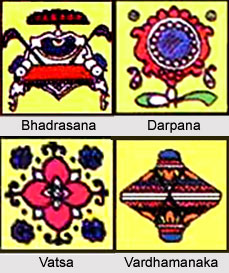
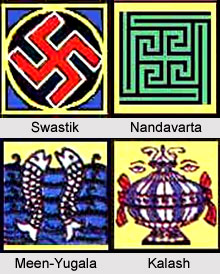
 Ashta Mangla in Jainism is the eight auspicious sacred symbols that are very significant for the Jains. They have been considered auspicious since time immemorial and have been depicted in the Kalpasutra. Ashta Mangla has high spiritual significance. According to scriptures every Jain has to draw these symbols before the icon of the Jain Tirthankaras before he begins his worship in the temple. These are drawn with pure unbroken rice grains. It is said that these symbols draw positive energies after they have been drawn and worshipped in the temple. It also ascertains the divinity of the deity and sanctity of a temple. Some have however, reduced this custom to the drawing of a swastika, along with three heaps of rice-grain that symbolises knowledge, vision and character. The eight auspicious sacred symbols are:
Swastika
Swastika is an auspicious symbol that is also known as sathia. It is customary and essential to draw the swastika at the commencement of all religious ceremonies.
Shri Vatsa
Shri Vatsa is another auspicious symbol that is drawn on the upper chest of all the 24 Jain Tirthankaras. The sign depicts the universal sympathetic eternal love for all living beings of the earth.
Nandavarta
Nandavarta is a holy complex form of swastika. It serves as the visual icon for advanced meditative attainment. It if formed by a beautiful arrangement of by nine angles or corners of divinity.
Vardhamanaka
 Varshamanaka is an earthen bowl that is sealed with another earthen bowl. It is used as a lamp. This pair of earthen bowls is known as samput in Sanskrit. This lit lamp symbolises the light that tries to remove to darkness of the world.
Bhadrasana
Bhadrasana is known as a holy seat or the royal throne. It is also considered as the sacred seat for the ones who have attained nirvana and are free from the cycle of birth and death. Bhadrasana is regarded as the seat of honour for evolved souls.
Kalasha
Kalasha is the holy pitcher that is drawn before a Tirthankara. Two divine eyes as well as two ends of a scarf are also drawn on either side of this Kalasha. This is a significant symbol of the Jains that plays an important role in every auspicious ceremony.
Meen Yugala
Meen Yugula is the fish couple. This couple form of the fish is regarded as very auspicious and divine. The sign depicts the flow of divine life in the cosmic ocean.
Darpana
The Darpana also known as mirror reflects the true self and nature of a person because of its clarity.