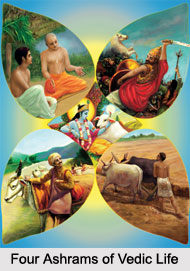
 Four Ashrams of Vedic life was based on an individual`s Karma and Dharma. Every doctrine of ancient India, carved out by the ancient saints, is based on scientific and rational reasoning. However, to put them to use they needed to be socially embedded. Hence methods like, the Ashram system, were included in the Vedic society. The average life of an Indian was considered to be 100 years. Based on this there were four ashrams of Vedic life- Brahmacharya, Grihastha, Vanaprastha and Sannyasa. The goal of each stage or ashram was to fulfil the ideals on which these stages were divided.
The stages of ashram life imply that an individual takes shelter in all the four stages of life depending on his age. These stages stratify the duties that man has to practice in his lifetime. These four divisions are elucidated in ancient Manu`s scripts. With such methodology the then contemporary society also aimed at holding the social institutions together. From an early age man was shown the paths of ethics, self-restraint, intelligence, pragmatism, love, compassion and discipline. He was guided to stay away from greed, cruelty, sloth, pride and several other vices. This system was also beneficial for the society at large.
According to the four ashrams of life a man was expected to lead his life in 4 stages: Brahmacharya: - This stage is the first one and it begins at the age of 20 and extends up to 25 years. In this stage man leads the life of student and practices celibacy. The motto of this phase is to train man to discipline himself.
Grihastha: - At this point of time man needs to pay heed to his social and family life. This phase begins from 25 and lasts till 60 years. Grihastha is a crucial stage in one`s life where man has to balance both his familial and social duties. He is married and manages his household and at the same time looks after the needs of the world outside. He has to discharge the duties of a son, brother, husband, father and a member of the community.
Vanaprastha: - This is the step to Partial renunciation. This stage ushers in the life of man at an age of 50 and lasts till he is 74. His children are grown up and he slowly moves away for the material ties. It is his age for retirement and starts walking on a path that will lead him to the Divine.
Sanyasa: The last stage in his life comes when he completely snaps off his worldly ties. This phase begins at 74 and lasts till he dies. He is completely free from the emotional attachments. He becomes an ascetic.
A true devotee is he who knows his duties and fulfils them. Society needs both kinds of people-he who abandons all to pursue god and he who stays within a social institution and strikes a balance between Karma and Dharma.