Home > Arts & Culture > Indian Monuments > Architecture Of Ahmedabad
Architecture Of Ahmedabad
Architecture of Ahmedabad mainly demonstrates the Islamic style as depicted in the mosques and mausoleums.

Share this Article:

Ahmedabad is the largest city in the state of Gujarat in West India. The city developed as a Muslim city because it was under the dominion of many Muslim powers. Thus the Islamic architectural style is the most prominent form of architecture in Ahmedabad. A blend of Indo Islamic style is also seen in some of the buildings and monuments. Apart from Islamic architecture there are also few specimens of Jain and Hindu architecture in the city of Ahmedabad. Buildings which have been constructed in the Post independence era are noteworthy architecture of this place.

This city of Ahmedabad was built in the year 1411 AD by Sultan Ahmed Shah and was ruled by the Ahmed Shahi dynasty during 15th-16th century and hence developed as a Muslim city. It served as the capital of the Gujarat sultanate. Ahmedabad was under Mughal control until 1578. Under the British rule a military cantonment was set up in this city and its infrastructure was modernised. Located on the bank of the Sabarmati River, Ahmedabad is noted for its rich collection of Islamic architecture.
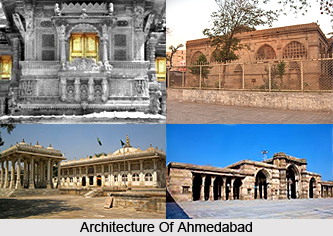
Architecture Of Ahmedabad Several Islamic architectures developed under the reign of Sultan Ahmed Shah, the founder of Ahmedabad. The Hindu and Jain temples were destroyed and the materials were used to construct mosques. The facade of the Ahmed Shah`s mosque has a large arch with two minarets on either side of the arch, thus paving the way for an innovative style of mosques, called the Gujarati style. Bibi ki Masjid is another example of mosque built by Ahmed Shah. The biggest mosque of Ahmedabad is the Jami Masjid Friday mosque the courtyard of which is surrounded by an enclosing corridor and enables the faithful to assemble for Friday prayers. In the centre of the facade is the three-arch entrance. It was built by traditional Indian craftsmen and architects. Having a row of pillars in the hall within the mosque, is Arabic in style. This monument of Ahmedabad displays a blend of Islamic and Indian architecture. The mausoleums like the tomb of Rani Sabrai is crowned with domes and Islamic parapets, pillar and beam structures, stone eaves, stone ceilings on the walls and filled with traditional craft.

The Havelis of Ahmedabad display the exquisite architecture of Gujarat. Detailed carving tech-niques have been perfected in the wooden architecture of Gujarat. These wood houses are still found in the old residential areas of Ahmedabad. The brackets, window frames, pillars, etc. that face the road are exquisitely carved. Post independent architectural style constitutes a major portion of architecture in Ahmedabad. For example the Mill Owner`s Association Building was designed by a British architect and has a concrete framework on both sides of the three storeyed domino box like building has brought in a lot of shade. This carved and sculpted kind of moulding goes well with traditional Indian architecture. The building of Indian Institute of Management in Ahmedabad has an architectural pattern with geometrical shapes blend-ed well with traditional Islamic architec-ture. The Gandhi Labour Institute built in 1984 resembles the architecture of Rajput palaces.

Ahmedabad is, thus, a storehouse of Islamic architecture. The exquisite structural design of the mosques and mausoleums enhances the architectural beauty of the city.
Share this Article:

Related Articles

More Articles in Indian Monuments


Monuments of Punjab
Monuments of Punjab are the founding stones of the state. Punjab has numerous historical monuments and religious monuments scattered throughout its different cities.throughout its different cities.
Monuments of Lakshwadeep
Monuments of Lakshwadeep are famous for their ancient religious feel and historical value.
Monuments of Jharkhand
Monuments of Jharkhand are well maintained by the state government as these are popular tourist destinations. These monuments are remnants of the history of the region, narrating significant incidents from the past.
Monuments of Haryana
Monuments of Haryana represent the glorious culture and history dating back to thousands of years. These monuments are popular for their historical, religious, or political significance.
Monuments of West Bengal
Monuments of West Bengal, mainly from the British era, are considered as priceless heritage of the state and attracts many tourists to the state.
Monuments of Andaman And Nicobar Island
Monuments of Andaman and Nicobar Island loaded with their rich past unveils the history of India. Most of the monuments here are reminiscence of dark and brutal rule of the British Empire in India.
Monuments of Andhra Pradesh
Monuments of Andhra Pradesh represents several wonderful and glorious sagas of various ruling dynasties of the past. Most of these monuments are protected by the government for their architectural excellence and historical significance.
Monuments of Chhattisgarh
Monuments of Chhattisgarh have a significant role to play in the state`s tourism. The land has a rich cultural and political history that is reminiscent in the historical forts, palaces and temples of Chhattisgarh and are great tourist attractions.
Monuments of Telangana
Monuments of Telangana covers the ancient, medieval and modern historical structures illustrating the architectural grandeur and attracting thousands of tourists throughout the year.
Monuments of South India
Monuments of South India show strong Dravidian traditions and are located in Tamil Nadu, Kerala, Andhra Pradesh and Karnataka.
Tombs in India
Tombs in India are famous all over the world for their architectural beauty and most of these tombs have been built in the medieval period. Travellers from all across the globe throng these historical sites.
Daulat Khana
Daulat Khana complex belongs to the early phase of Nawabi construction in Lucknow. It was commissioned to be built by Nawab Asaf ud Daulah. The Daulat Khana Complex consists of the Shish Mahal, the Shish Mahal Ka Talab and the Baradari Shish Mahal.
Mahesh Vilas Palace
Mahesh Vilas Palace is located in the state of Uttar Pradesh amidst 35 acres of Lush Green Lawns, Fountains and Orchards.
Architecture Of Andhra Pradesh
Architecture of Andhra Pradesh is an illustration of diverse types of Hindu, Buddhist and Islamic architectural styles.
Architecture Of West Bengal
Architecture of West Bengal comprises Hindu temples, Muslim, Buddhist and Colonial monuments and the unique terracotta style.
Architecture of Lucknow
Architecture of Lucknow is mostly Islamic in nature. It is representative of 18th and 19th century Indian architecture. The architecture is broadly divided into religious architecture, such as that of Imambaras and secular architecture, such as that of Baradaris and Kothis.
Cheena Kottaram
Also known as the China Palace, the Cheena Kottaram used to be a rest house for the then King of Travancore.
History of British Architecture in India
History of British architecture in India had begun with a solemn promise, keeping no stones unturned. This line of architecture invaded in India from the early colonial times in the states like Delhi, Kolkata, Mushidabad and Pune.
Monuments of Assam
Monuments of Assam are timeless remnants of historical masterpieces which reflect the architecture of ancient Assam. these monuments are remnants of the glorious history of the region under different rulers.
Bharhut Stupa
Bharhut Stupa is situated between Jabalpur and Allahabad in the erstwhile Nagod state of Madhya Pradesh. In 1873, the place was discovered by Sir Alexander Cunningham.