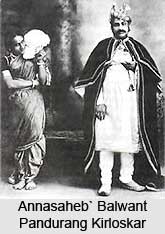
 `Annasaheb` Balwant Pandurang Kirloskar was born in 1843. He was popularly known as the father of modern Marathi Theatre. He was a Playwright, actor, director, and composer; he founded the Sangitnatak to counter the influence of Parsi-Gujarati theatre and its music on Marathi audiences. He was born at Gurlhosur in Dharwad in Karnataka, where he received his primary education. He came to Pune for further schooling and developed an interest in theatre. He was well versed in Sanskrit literature and a budding poet. He started experimenting with productions of mythological drama for the Bharat Shastrottejak Mandali. He gave up these attempts, went back to Gurlhosur, failed the law examination, and took up various jobs as teacher and revenue clerk in Belgaum, Karnataka.
Kirloskar began to write a historical play on Allauddin`s invasion of Chittorgarh, but left it unfinished. In 1873 he completed his first prose drama, Shankardiguijay i.e. `Shankaracharya`s Conquests`, for the Kolhapurkar Natak Mandali. Inspired by a Parsi theatre opera, he translated Kalidasas Sakuntala as Shakuntal. This was termed as the first Sangitnatak by many scholars. He established the Kirloskar Natak Mandali in Belgaum. This staged the first four acts in 1875 and encouraged by the overwhelming response produced the entire play in Pune in 1880. This won him immense popularity. In 1882 he wrote Sangit Saubhadra i.e. `Musical of Subhadra`. This was a mythological love story influenced by English Romanticism, even more popular for its plot structure and songs. His third play, Ramarajya viyoga i.e. `Rama Giving up His Kingdom` in 1882, remained incomplete. The company staged its first three acts in 1884. Balwant Pandurang Kirloskar was a good actor and director. Kirloskar brought several innovations on the Marathi stage. He rejected the formal features of Vishnudas Bhave`s style, like the entry of the sutradhara, vidushaka, Ganapati, and Saraswati, in that order, and applied instead the Sanskrit convention of the sutradhara, his companion, and nati i.e. actress appearing only in the initial sequences. His well-organized plots, fine characterization, and romantic atmosphere reflect the impact of English drama. His most important contribution was the development of a form that integrated music and theatre. In these theatres the characters themselves sang, not the sutradhara or singers backstage.
Kirloskar used and popularized Hindustani and Carnatic classical as well as folk music in his compositions. They served as models for later playwrights. Even after his death, the Kirloskar Natak Mandali reigned supreme for over thirty years with the plays of Deval and S. K. Kolhatkar. It toured across Karnataka, Maharashtra, and Maratha princely states in north India. It had several star singer-actors in its employ, such as Bal Gandharva, Govindrao Tembe, `Master` Krishnarao, and Ganesh Bodas, and influenced theatre with the excellent standards it established through its productions. The company received a blow when Bal Gandharva left with Tembe and Bodas, but survived with another set of artistes including Dinanath Mangeshkar, who breathed new life into it. However, they departed too because of financial mismanagement, and this glorious chapter in Marathi theatre history closed around 1935. `Annasaheb` or Balwant Pandurang Kirloskar died in 1885 at very young age of 42 years.