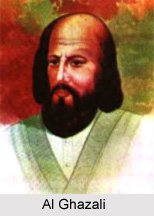
 Al Ghazali was among one of the most important and influential Muslim theologians of all time. He is a very important figure in the history of mysticism. Most of the Scholars consider him the most congenial and most approachable of Muslim theological writers. He is commonly known as al Ghazali or Algazel. He is often referred to by Arabic writers by his "father-name" (Kunya) of Abu Hamid ("father of Hamid"). His own name was Muhammad, and he had a brother called Ahmad, who was noted as a mystic and wrote books in Persian.
The expansive knowledge about the life and works of al Ghazali is available from the autobiographical work that he has left behind. Its title may be translated as Deliverance from Error. His life has not been treated in a chronological manner in this work probably because this work is more an intellectual defence of his beliefs. He recounts how, after a period of sheer scepticism, he set out on a quest for truth, and examined in turn the results achieved by the four main classes of `seekers after truth` in his own day- the theologians, the philosophers, the Ismailites and the Sufis. This narration is not accurate chronologically, yet it is convenient to follow it in considering his contributions to the thought of his time.
Early Life of Al Ghazali
The theologian was born at Tus (near the modern Meshhed in Persia) in 1058, and received his early education there. For the later stages of his education he went abroad, as was the custom, first to Gurgan (Jurjan) at the south-east corner of the Caspian Sea, and then, perhaps about 1077, to the nearer Nishapur. Here, besides continuing his legal studies, he was introduced to theology and possibly also philosophy by al Juwayni. On the death of al Juwayni in 1085 he went to the "camp" of Nizam al Mulk, and took a prominent place among the many scholars there, so that in 1091, while still very young, he was appointed to a professorship at the Nizamiyya College in Baghdad. For four years he was a popular lecturer here with over three hundred students in his audience.
Philosophical Beginnings of Al Ghazali
While he was teaching, he was privately reading and gaining a thorough grasp of the philosophy of al Farabi and Avicenna-something no theologian had hitherto done. First he wrote a lengthy objective summary of their views (which was translated into Latin in the Middle Ages and because of its lucidity became influential). Then he wrote a devastating criticism of their views, `The Inconsistency of the Philosophers.` He also produced several other works about the same time.
Mysticism of Al Ghazali
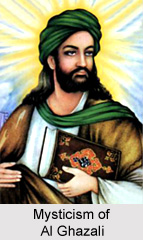 Despite his phenomenal outward success, however, he constantly felt that he was in grave danger of hell-fire. In July 1095 the inner conflicts produced a physical symptom, an impediment in speech which prevented him from lecturing. After several months of great interior suffering he left Baghdad in November 1095, ostensibly to make the Pilgrimage to Mecca, but really with the firm intention of abandoning his career as a jurist, theologian and university professor in order to serve God more completely as a poor Sufi (mystic). It is possible that a bad relation with the new Seljuq ruler Barkiyaruq, who was recognized in Baghdad in February 1095, was a factor in his decision. Another deeper reason could have been his disgust at the blatant worldliness of most of his colleagues among the Ulema (the jurists and other scholars), and it may be that his chief reason for abandoning his career was the impossibility, as he felt, of living an upright life in this environment.
From Baghdad he went first to Damascus. A misinterpretation of one of his own statements has led many scholars, both ancient and modern, to think that he spent the next ten years between Syria and the Hijaz. But more careful study of all the available source-material makes it clear that this was not so, and that the ten years of withdrawal from the world were spent rather as follows. He did not go on pilgrimage immediately after his departure from Baghdad, but waited until the pilgrimage of the following year, in November and December 1096. Either before or in the course of his journey to Mecca he visited Jerusalem and Hebron, but he almost certainly did not go to Egypt, as is sometimes stated. Soon after the pilgrimage he returned to Iraq, for he was seen in Baghdad in June, 1097. After a stay there lasting a few months or perhaps more than a year he returned to his native town of Tus, where he lived the life of an ascetic and mystic and gathered round him a community of disciples. These shared his practices and received instruction from him.
At the end of 1104 there was another change of Seljuq ruler, and the post of vizier came into the hands of a son of Nizam al Mulk who prevailed on al Ghazali to return to academic lecturing in Nishapur, presumably in the Nizamiyya College. One of the considerations that weighed with him was a Tradition in which the Prophet Muhammad asserted that at the beginning of each century a "renewer" of his religion would appear; they were now in the closing months of the fifth Islamic century, and many friends assured him that he was the destined "renewer" for the next century. So to Nishapur he went in July 1106 and remained there at least three years. Finally, whether because of ill-health or for some other unknown reason, he returned to Tus, and died there in December 1111.