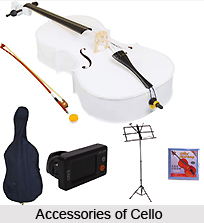
Accessories of Cello
Accessories of cello forms an important part in the construction of the instrument.

Share this Article:

Accessories of CelloAccessories of cello can be divided into various types. These accessories play a very important role for the maintenance of the instrument.

There are also cases that are used to protect the bow and cello (or many bows) when travelling and for storing it safely. They are also made of fibre-glass, carbon fibre and less commonly wood.

Rosin, which is made from resins of conifers, is applied to bow hairs to enhance the effectiveness of friction, bite or grip and also allow proper sound productions. Rosins may have additives to modify the friction like the beeswax, sliver, gold or tin. Commonly the rosins are classified as either Light or Dark. Dark rosins increase the friction more than the Light rosins does.

Endpin straps or stops keep the cello from sliding if the end pin does not have rubber piece on the end though in many ways a rubber piece will actually not suffice on even a wooden floor. There are many cellists who actually use the square and rectangle of the carpet to secure under the front two legs as an endpin stop. However, this is less likely to be seen in a professional field and more used in rehearsal or in private.

The wolf-tone eliminators are many times placed on cello strings between the tailpiece and the bridge to get rid of acoustic anomalies called wolf tones or "wolfs".

Mutes are also used to change the sounds of cello by decreasing the overtones. Practise mutes also significantly reduce the volume of the instrument. The most common mute is a rubber disc with two holes to fit the two middle strings. It sits just after the bridge and also has a flap that can also be placed over the top of bridge to mute the vibrations travelling down it to the sound post inside the cello.

The Metronomes provide a steady tempo by sounding out a certain number of beats per minute. They can be adjusted to fit the tempo of the piece. Many models can also produce a tuning pitch of A4, among others. These, certainly can be used for other instruments.

The Humidifiers are also used to stabilize and control the humidity around and inside the cello and are famous with cellist who travel. Often, these are also placed inside the cello itself or inside the case. Some players, however, do not use the humidifier inside their cellos because in case the potential dips, it may cause damage to the instrument.

Electronic tuners are sometimes used to tune the instrument. A tuner indicates if a note that is played is flat or sharp.
Share this Article:

Related Articles

More Articles in Music in India


Manjira - Musical Instrument
Manjira, also known as tala, manjeera, jalra, kartal, or khartal, is a traditional Indian percussion instrument. It consists of a pair of small hand. Manjira is widely used in religious ceremonies, folk music, and classical performances, showcasing its versatility and cultural significance.
Bhavageete
Bhavageete is a form of expressionist poetry in light music. It is a significant genre of folk music that unfolds the realities of life in an eloquent manner.
Kriti Carnatic Music
Kriti refers to one of the most widely used genres of Carnatic music. It originated from the kirtanas of the bhaktas, i.e., musicians who expressed their religious devotion through songs.
Music of Uttarakhand
Music of Uttarakhand has its roots in nature. The folk music of Uttarakhand is based on traditions, festivals and folk legends.
Music of Arunachal Pradesh
Music of Arunachal Pradesh reflects the socio cultural life of the people of that state. Music forms an integral part of the festivities of Arunachal Pradesh.
Rajasthani Musical Instruments
Rajasthani musical instruments are widely used as accompaniments as well as individually for entertainment.
Music of Tamil Nadu
Music of Tamil Nadu has an eminent charisma that reflects the pristine essence of the ancient art and culture of the region.
Thumri
Thumri belongs to the light classical genre of North Indian Classical Music that originated in the 15th century. It is known for its emotive melodies, poetic lyrics, and expressive renditions. Primarily sung by female vocalists, Thumri has evolved into a cherished form of music, captivating audiences with its melodic compositions.
Music of Kerala
With its origin in the primitive dances and plays, the music of Kerala has evolved to a high aesthetic sensitiveness and great technical sophistication since ancient times.
Ektara String Instrument
Ektara is a one-string instrument which is most often used in folk music in India. The Ektara was a regular string instrument of wandering bards and minstrels from India and is plucked with one finger.
Indian Musical Instruments
Indian musical instruments can be broadly classified into four categories like stringed, wind, Ghana Vadya and percussion.
Indian Folk Music
Indian Folk Music is full of rustic charm. The appeal of Indian folk music lies in the simplicity of its style and lyrics. Most of the folk songs are accompanied by dances.
Musical Instruments of Assam
Musical Instruments of the Assam are numerous which brings out the richness of the folk culture of the state.
Haryanvi Music
Haryanvi music is the folk music of the state of Haryana and is sung in western Uttar Pradesh along with the neighbouring districts of Rajasthan and Punjab.
Folk Music of West Bengal
Folk Music of West Bengal is practiced in different parts of West Bengal which is the semi-classical devotional genre of Kirtan.
Indian Classical Music
Indian Classical music originated in the Vedas and later branched into two streams of Carnatic and Hindustani music.
Musical Instruments of Ancient India
Musical Instruments of Ancient India, since time immemorial have contributed in making the Indian music more enchanting. A number of instruments have developed over time, which still finds a significant place in the music of modern era.
Carnatic Music
Carnatic music, also known as `Karnataka Sangitam`, is one of the two styles of Indian classical music.
Dotara - Muscial Instrument
The Dotara is a traditional musical instrument originating from Eastern India. This plucked-string instrument holds cultural significance in the region, producing melodious tunes that have been cherished for generations.
Tumbi Muscial Instrument
Tumbi is a type of string instrument that is mostly used in north Indian folk music. It features a high-pitched sound produced by a single metallic string. Popularized by Punjabi singers, the Tumbi has also made its mark in Western music also.
Xylophone Musical Instrument
Xylophone is a musical instrument consisting of several wooden bars which are struck with mallets; it belongs to the family of percussion instruments.