Introduction
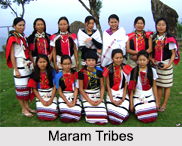 Maram Tribes are one of the sub-tribe of Naga tribes inhabiting at Senapati district of Manipur of northeast India. They are mainly found in Tabudi sub-division of Senapati district. It is the only tribe of Manipur which has been included in the list of primitive tribal groups of India.
Origin of Maram Tribes
Maram Tribes are mainly scattered in various areas like Senapati district, Tadubi Sub-division and also Kangpokpi region. The origin of Maram tribes has a rich heritage behind it. In their cosmology, amongst three sons Karambungsa, the eldest brother Makikangba is considered to be ancestor of the Maram tribes. They are considered to be a part of Tibeto-Burman family of Mongoloid race. Linguistically, they belong to the sub-family of the Sino-Tibetan family.
Clans of Maram Tribes
The Maram tribe follows the ascending and descending genealogical lines through males only. Maram tribes have three localized descent groups - Lamkana, Magai-Bungnamei and Kagama. Each of the clans of Maram Tribes is an exogamous unit and has a number of sub-lineages. These major clans are Punglunamei, Rangnamei, Karangnamei, Naguina or Naguna, Bungnamei, Magaimei, Puinarnei, Najangmei or Nakijkoinamei or Majangmei and Kashammei or Kishumei.
Society of Maram Tribes
 Among the Maram, the dormitory for the unmarried boys is called "Hangsaki" and "Kailiu" for the dormitory of the girls. The members learn their customs, folklore, folktales, dance, music, song and discipline from their seniors. Due to the influence of Christianity the role of youth dormitory is weakening gradually.
Monogamy is the common form of marriage and polygamy is rare. They follow serial monogamy and straight monogamy. Tattoo painting is prevalent among the women.
Festivals of Maram Tribe
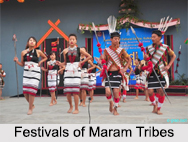
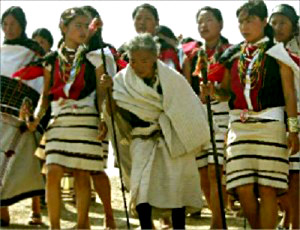 Festivals of Maram Tribes include mainly Ponghi, Rakak and Kanghi and many others to be mentioned. They celebrate numerous festivals round the year. Their rich cultural heritage is reflected in their beautiful art form during their great festivals. Their festival mainly involves invocation and glorification of gods during which people observe certain ideals followed by community feast.
Since they are agriculturist by profession their festivals in relation with different stages of agricultural activity according to the lunar months. People consider festivals as an opportunity of expression of their artistic talents, physical strength through martial arts, dance and songs.
Some important festivals are described below:
Ponghi festival
Ponghi festival is a festival of cultivation. The offering of a clean cow is related to a good harvest for the current year. This festival is celebrated in the month of July every year at village level and is completed in seven days. This cow is first of all sprinkled with pure water and then it is slaughtered. This is followed by many more animal sacrifices. Animals are killed throughout the festival. Third day of the festival is meant for the married couples as they exchange their gifts with each other.
Rakak festival
This is the annual festival celebrated in the month of November. It is meant for the dead so the family whose family members died in the current year arranges a last mortuary feast. It is also known as anniversary feast for dead. Their belief is that after this feast the departed souls leave the village. In this feat a cock is sacrificed and cooked outside the house and offered to the souls by village priest.
Konghi festival
This festival is celebrated in the month of December every year. It is a grand feast for the youth. It lasts for seven days. This festival is also known as Khanghika or Kangisangi. The youth remain busy in different works like preparation of rice-beer, collection of fire wood and so on. The seven days are called as -Lingshamasui, Wangnimatam, Ngeedi, Matoh, Sabangha, Hangira and Thangera respectively.
The festival starts with kitting buffalos and cows. On the second day, the small children play with cocks which are again slaughtered in the evening. Wrestling competition is held for the village youth. Boys and girls assemble in their respective dormitories where they prepare meal and meat on the third day. Food items are exchanged with each other and then the villagers take part in grand feast. A dog is killed by the boy and head of the dog is to be given to girl`s dormitory for their solemn meal. Married women serve rice-beer to their parents. Long jump competition between lineages and clans take place on the fourth day. Fifth day is the wrestling competition day. The competition is held before the village Khullakpa. All male participants go to near by spring for taking compulsory bath before starting the competition which is called Aduikung. After receiving blessing from Khullakpa, the competition starts in presence of him. On the last two days, the boys and girls exchange rice-beer with each other to express their festive joy.
Mangkhang festival
This festival is a farewell feast which is given to newly married couples of the current year. It is celebrated in the month of April with aiming the good health of the villagers and the welfare of newly married girls. Each family sacrifices a cock to observe the luck for the current year. A feast of pure non-vegetarian is prepared for this festival. The parents of newly married girls are responsible for arranging this. Married girls perform a kind of dance in the evening which is called Pusuba.
Economic Life of Maram Tribes
Maram tribes are agriculturist and all agricultural activities are governed by their own customs. Shifting cultivation is the main cultivation practiced by them. They are also involved into wet cultivation. Paddy, maize, millet, bean, pumpkin, turmeric, ginger, chilli, cucumber, gourd, sweet potato, pulses and taro are grown through Jhum cultivation. Hunting is the secondary occupation of Maram tribes. They hunt whatever the animals or birds they get to see in the nearby forest. Basketry is the traditional occupation of Maram tribe.
Religious Life of Maram Tribes
Maram tribes are the worshippers of supernatural benevolent and malevolent beings. They offer worships by performing various rituals. These rituals satisfy various spirits and drive them away. They mainly worship "Pantheon". "Akrkot" is their house deity, while "Powmungba" is a wind deity. "Sara Kachinu", "Paranhaba" are some of the deities of Maram.
Dance and Music of Maram Tribes
The Maram tribes are very rich in dance, folksongs and traditional music. They perform dance and music in all socio-economic and religious occasions. Sarukatu dance is a war dance which is also very popular. Pahakatu is a traditional female dance which is performed by young girls. Pasuba is a dance performed by married girls. There are few other types of dances like the Bangkatu and Ngang katu which are performed in big festivals.