Home > Travel > Hill Stations in India > History of Male Mahadeshwara Hills
History of Male Mahadeshwara Hills
The history of the Male Mahadeshwara Hills is deeply rooted in legend and devotion, tracing back nearly six centuries. Associated with Saint Mahadeshwara, believed to be an incarnation of Lord Shiva, the region evolved into a sacred centre blending spiritual tradition, folklore, and enduring cultural heritage.

Share this Article:

Introduction

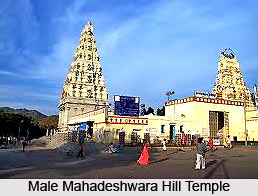
Male Mahadeshwara Hill is a pilgrim town situated in the Hanur taluk of the Chamarajanagar district in southern Karnataka. The ancient and sacred temple at Male Mahadeshwara Hill stands as a revered spiritual centre, believed to be the place where Mahadeshwara lived. Renowned as a Siddha practitioner, he is said to have practiced medicine and imparted the principles of ahimsa to communities across the surrounding seven hills. Today, the shrine attracts lakhs of devotees each year from Karnataka and Tamil Nadu, reaffirming its enduring religious and cultural significance.


History of Male Mahadeshwara Temple

Junje Gowda is remembered as the legendary builder of the Male Mahadeshwara Temple in the Hanur taluk of Chamarajanagar district. A local landlord from the Kuruba community, he was a devoted follower of Shri Mahadeshwara Swamy. Lord Sri Mahadeshwara is widely believed to be an incarnation of Lord Shiva. Historical evidence suggests that Saint Mahadeshwara lived during the 15th century. Nearly 600 years ago, he is said to have arrived at this sacred site to undertake penance, and tradition holds that he continues this penance within the temple’s Garbha Gudi in the form of a Linga. The Linga worshipped in the sanctum today is regarded as swayambhu, or self-manifested, further enhancing the temple’s spiritual significance.


Geographical Significance of Male Mahadeshwara Hills

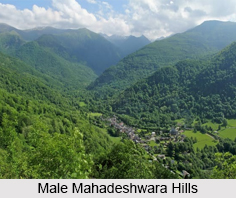
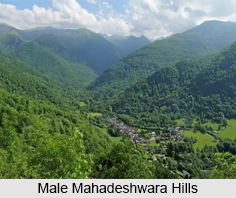
The Male Mahadeshwara Hills are situated in the northeastern section of a detached extension of the Western Ghats, projecting northeastward along the southern edge of the Deccan Plateau. Along with the Biligiriranga Hills, this range forms a significant geological link between the Eastern Ghats and Western Ghats. The region is separated from the Nilgiri Hills by the Moyar River.

The Male Mahadeshwara Hills are bounded by the Kaveri River to the north and east, while the Palar River, a tributary of the Kaveri, flows along the southern boundary. The confluence of these two rivers lies at the southeastern corner of the Male Mahadeshwara forest, with the Stanley Reservoir located further downstream.

The hills have an average elevation of approximately 3,000 feet (910 metres). The highest peak in the range is Ponnachi Betta, which rises to an elevation of 1,514 metres (4,967 feet) above sea level.

Beyond its significance as a pilgrimage centre, the Male Mahadeshwara Hills encompass vast stretches of forestland rich in sandalwood and bamboo. The landscape of the hills and valleys is blanketed by diverse forest types, ranging from evergreen forests in the Ponnachi region to predominantly dry deciduous forests across much of the area. These forests support a wide variety of wildlife, including numerous species of animals, birds, and reptiles, many of which are found in significant numbers. Among them, elephants stand out as the most prominent and iconic inhabitants of the region.


Legend of Male Mahadeshwara Hills

According to legend, Male Mahadeshwara was born to Chandrashekara Murthy and Uththarajamma in the Madiga community. He is believed to have visited the home of Junje Gowda, a wealthy landlord of the Kuruba Gowda caste and a devotee of the deity Beredevara. During his stay, Mahadeshwara is said to have performed several miracles to demonstrate his divine power, ultimately winning Junje Gowda’s devotion and allegiance.

Junje Gowda is traditionally credited with the construction of numerous temples across the mountainous region of eastern Karnataka known as the Mahadeshwara Hills. Even today, the descendants of the Junje Gowda family are believed to reside in the village of Kadamboor in Hanur taluk of Chamarajanagar district, preserving a living link to this sacred history.


Legend of Sri Male Mahadeshwara

Lord Male Mahadeshwara, after whom the hills are named, is believed to have been born during the Kali Yuga. In his early years, he is said to have received spiritual guidance from the pontiffs of Suttur Mutt and Kunthur Mutt. Tradition holds that the young saint journeyed from Srishaila to this region of the state, where he performed several miracles during his lifetime. He later withdrew to the hillside region now known as the Male Mahadeshwara Hills.


At the time, the Male Mahadeshwara Hills were a dense forest landscape, encircled by seventy-seven hills arranged in seven concentric circles, making it unsafe for human habitation. Nearly six centuries ago, the young saint is believed to have entered this forested area to rescue sages who were engaged in penance and had been captured by an evil king named Shravana, who was reputed to possess formidable black magic powers. The region was also inhabited by scattered tribal communities living in isolation, untouched by the influences of organized human civilization.

Legend recounts that Lord Sri Mahadeshwara destroyed Shravana’s black magic and freed the imprisoned saints. The site where the sages were held captive is revered today as Thavasere, while the place associated with Shravana’s residence is known as Shravana Boli, both regarded as sacred landmarks within the Mahadeshwara Hills.


Male Mahadeshwara Hills in Puranas

According to Puranas, the seven peaks of Male Mahadeshwara Hills surrounding Male Mahadeshwara Temple, are identified as Anumale, Jenumale, Kanumale, Kadumale, Pachchemale, Pavalamale, and Ponnachimale. Together, these seven peaks form the sacred Male Mahadeshwara Betta. It is believed that Saint Lord Mahadeshwara established a Mutt at this site to oversee the religious and cultural affairs of the people in the region.

Legend further holds that through his miracles, Lord Mahadeshwara enlightened and uplifted the hill tribes, accepting them as his disciples. Descendants of these families continue to serve as hereditary Archakas of the Mahadeshwara Temple. Historically, the temple remained under the control and management of Sri Salur Mutt, which was established by Lord Mahadeshwara himself, until it was transferred to the Madras Government in 1953. Following the formation of the state of Karnataka, the administration of the temple has been managed by a trust committee appointed by the Karnataka Government under the Muzrai Department.


Share this Article:

More Articles in Hill Stations in India


Tourism in East Khasi Hills District
Tourism in East Khasi Hills District offers a pleasurable experience to the travellers. Magnificent lakes, waterfalls, parks and caves are some of the tourist attractions offered by East Khasi Hills District.
Jaintia Hills District
Jaintia Hills District is an administrative district of Meghalaya and its headquarters are located at Jowai. Economy of Jaintia Hills District is mainly agrarian in character as most of the people are engaged in agriculture.
Ananthagiri Hills
Ananthagiri Hills is an important tourist destination in Telangana. It serves as the pilgrimage tourism site and the leisure tourism site in this state.
Mahendragiri Hill
Mahendragiri is a place of great scenic beauty. The place is surrounded on three sides by hills and thick growth of wild trees.
Agumbe Hill Station
Agumbe Hill Station in Karnataka is a well-known tourist spot for its sunsets, waterfalls research unit on king cobras.
Yercaud Hill station
Yercaud is a fascinating hill station of Tamil Nadu, situated about 8 kms from Salem.
Langudi Hill
Langudi Hill, Odisha is a significant Buddhist archaeological site containing ruins of Pushpagiri University, rock-cut caves, Buddhist stupas and numerous other Buddhist relics.
Tendong Hill
Tendong Hill in South Sikkim is located at an altitude of 8530 ft. The hill is deeply revered by the local villagers.
Kolli Hills
Kolli Hills is a small mountain range located in Tamil Nadu. It is a part of the Eastern Ghats and serves as a great tourist spot.
Netarhat
Netarhat is a well known town, known as the ‘Queen of Chotanagpur’ region. This is one of the major hill stations which attract the tourists for its exquisite natural beauty on the plateau regions.
Male Mahadeshwara Hills
The Male Mahadeshwara Hills is one of the popular sites of tourism in the state of Karnataka and is known for the sacred Male Mahadeshwara Hills Temple that attracts tourists from all around.
Igatpuri
Igatpuri is a town in Nashik District of Maharashtra. This town in Maharashtra is famous for Vipassana International Academy.
Javadhu Hills
Javadhu Hills is a prominent tourist attraction in Tiruvannamalai district of Tamil Nadu. This place attracts the people who come to visit Ooty and its adjacent sites.
Thakurani Hill
Thakurani Hill is a residual sedimentary hill in Odisha and it is the place of attraction in Keonjhar District.
Nilagiri
Nilagiri is a hill town and it is now called as the hill station in the Eastern Ghats Mountain Range in India, now the major attraction to the tourists for its natural beauty.
Khandala
Khandala is one of the popular hill stations in Maharashtra. A famous getaway spot for people from Mumbai and Pune, it is known for Tiger`s Leap, Bedsa Caves, Karla Caves Duke`s Nose etc.
Hill Stations in Chattisgarh
Hill Stations of Chhattisgarh is offering with the caves, archaeological ruins, waterfalls, national parks, lakes and rich wildlife and tribal cultural heritages.
Lambasingi
Also known as the Kashmir of Andhra Pradesh, the small village of Lambasingi is a popular tourist destination.
Khonsa
Khonsa is a hill station in Arunachal Pradesh. This hill station offers the national and international tourists as a famous nature and leisure tourism sites.
Nallamala Hills
Nallamala Hills is an Indian hill station located in the South Indian states of Andhra Pradesh and Telangana. The region also houses some tourist spots among which Srisailam Dam and Cumbum Lake are the most popular ones.